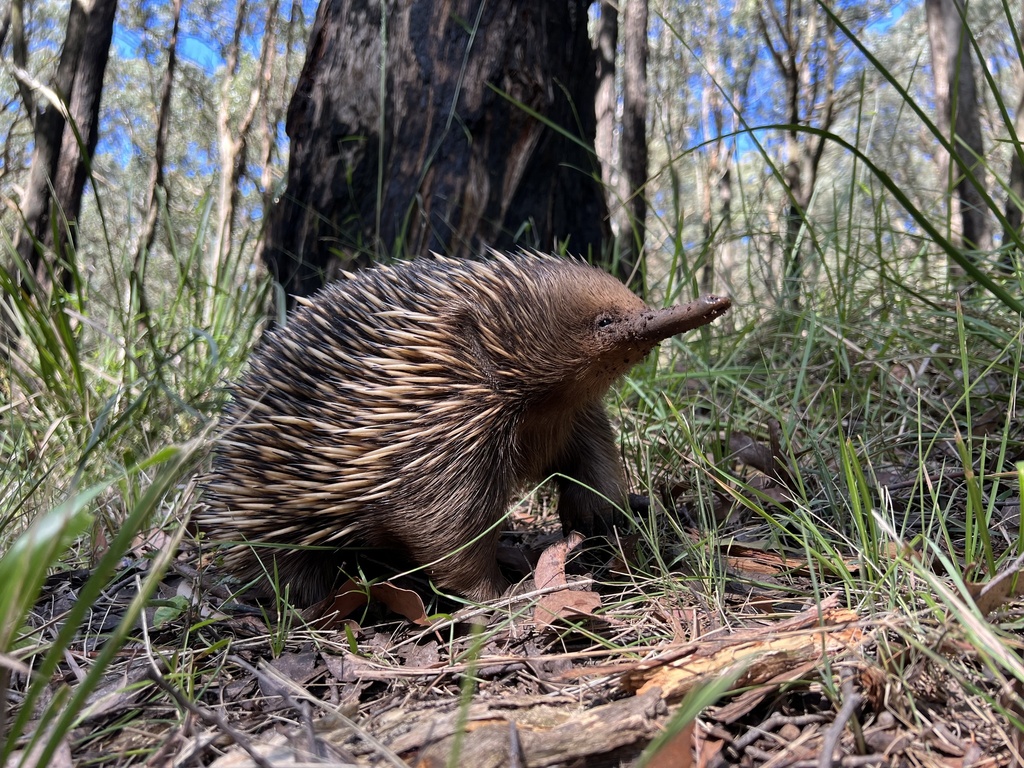
Short-beaked Echidna
Tachyglossus aculeatus
- Class
- Mammal
- Rarity
- Common
- Observations
- 18,297
- Most observed in
- 🇦🇺 Australia
- Conservation
- Least Concern
Description
The short-beaked echidna (Tachyglossus aculeatus), also known as the common echidna, or short-nosed echidna, is one of four living species of echidna, and the only member of the genus Tachyglossus, from Ancient Greek ταχύς (takhús), meaning "fast", and γλῶσσα (glôssa), meaning "tongue". It is covered in fur and spines and has a distinctive snout and a specialised tongue, which it uses to catch its insect prey at a great speed. Like the other extant monotremes, the short-beaked echidna lays eggs; the monotremes are the only living group of mammals to do so. The short-beaked echidna has extremely strong front limbs and claws, which allow it to burrow quickly with great power. As it needs to be able to survive underground, it has a significant tolerance to high levels of carbon dioxide and low levels of oxygen. It has no weapons or fighting ability but deters predators by curling into a ball and protecting itself with its spines. It cannot sweat or deal well with heat, so it tends to avoid daytime activity in hot weather. It can swim if needed. The snout has mechanoreceptors and electroreceptors that help the echidna to detect its surroundings. During the Australian winter, it goes into deep torpor and hibernation, reducing its metabolism to save energy. As the temperature increases, it emerges to mate.
Summary adapted from the Wikipedia article “Short-beaked echidna”.