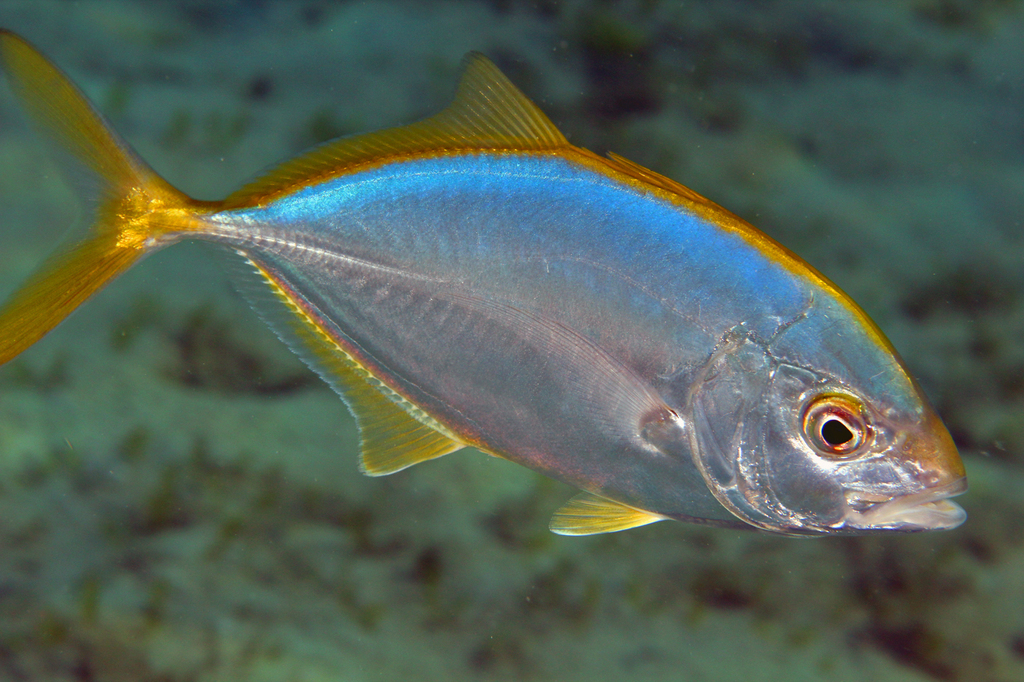
Yellow Jack
Caranx bartholomaei
- Class
- Ray-finned fish
- Rarity
- Common
- Observations
- 641
- Most observed in
- 🇺🇸 United States
- Conservation
- Least Concern
Description
The yellow jack (Caranx bartholomaei), also known as coolihoo, is a species of marine fish in the jack family, Carangidae. It is one of only two representatives of its genus present in the Atlantic Ocean, inhabiting waters off the east coast of the Americas from Massachusetts in the north to Brazil in the south, as well as a number of offshore islands. The yellow jack can be distinguished from closely related species by the length of the jaw, as well as counts of the rays in the fins. It is a fairly large fish, growing to a recorded maximum length of 1 metre (39 in), and a weight of at least 14 kilograms (31 lb). Yellow jack inhabit reefs, moving either individually or in schools and are predatory fish which primarily take other small fish. Studies in the Caribbean suggest the species reaches sexual maturity between 23 and 32 centimetres (9.1 and 12.6 in), and spawns in offshore waters from February to October. Yellow jack are of minor economic importance, taken by both hook and net methods, and are considered to be fair table fish. They are often caught by boat anglers, although are overlooked for their larger relatives.
Summary adapted from the Wikipedia article “Yellow jack”.