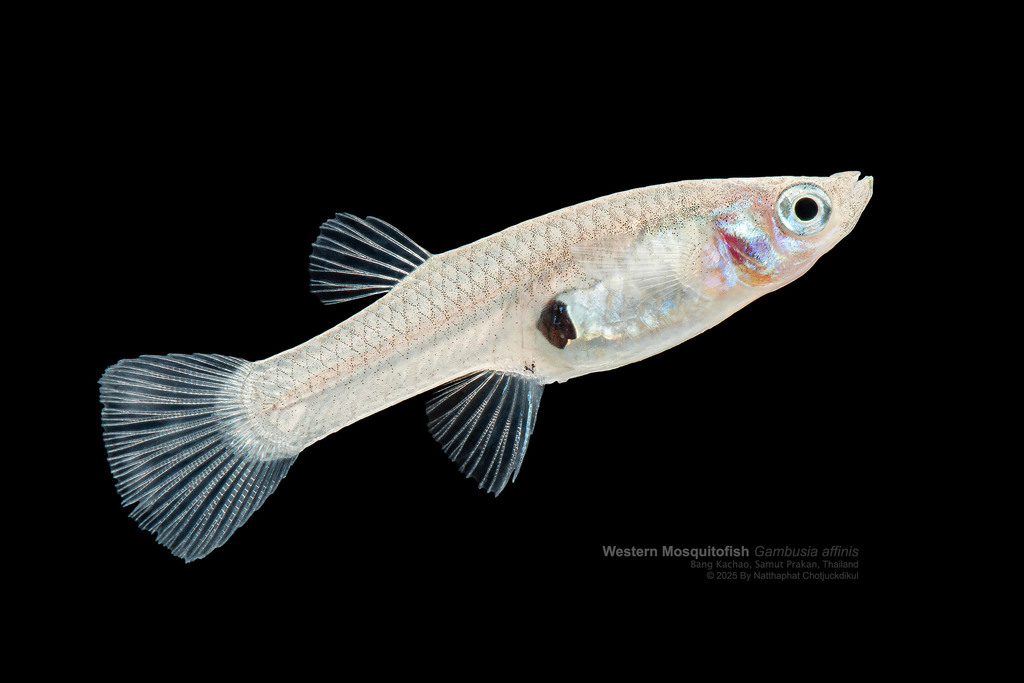
Western Mosquitofish
Gambusia affinis
- Class
- Ray-finned fish
- Rarity
- Common
- Observations
- 13,886
- Most observed in
- 🇺🇸 United States
- Conservation
- Least Concern
Description
The western mosquitofish (Gambusia affinis) is a North American freshwater poeciliid fish, also known commonly, if ambiguously, as simply mosquitofish or by its generic name, Gambusia, or by the common name gambezi. Its sister species, the eastern mosquitofish (Gambusia holbrooki) is also referred to by these names. Mosquitofish are small in comparison to many other freshwater fish, with females reaching a maximum length of 7 cm (2.8 in) and males a maximum length of 4 cm (1.6 in). The female can be distinguished from the male by her larger size and a gravid spot at the posterior of her abdomen. The name "mosquitofish" was given because the fish eats mosquito larvae, and has been used more than any other fishes for the biological control of mosquitoes. Gambusia typically eat zooplankton, beetles, mayflies, caddisflies, mites, and other invertebrates; mosquito larvae make up only a small portion of their diet. Mosquitofish were introduced directly into ecosystems in many parts of the world as a biocontrol to lower mosquito populations which in turn negatively affected many other species in each distinct bioregion. Mosquitofish in Australia are classified as a noxious pest and may have exacerbated the mosquito problem in many areas by outcompeting native invertebrate predators of mosquito larvae. Several counties in California distribute mosquitofish at no charge to residents with human-made fish ponds and pools as part of their mosquito abatement programs.
Summary adapted from the Wikipedia article “Mosquitofish”.