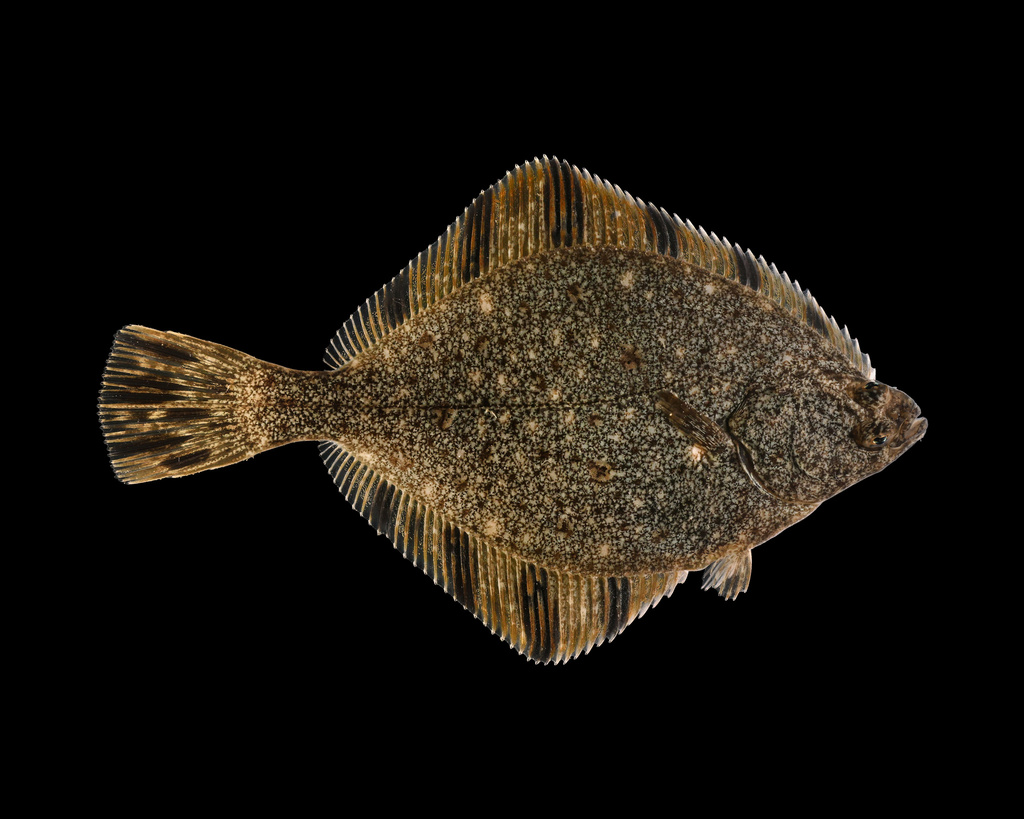
Starry Flounder
Platichthys stellatus
- Class
- Ray-finned fish
- Rarity
- Common
- Observations
- 844
- Most observed in
- 🇺🇸 United States
- Conservation
- Least Concern
Description
The starry flounder (Platichthys stellatus), also known as the grindstone, emery wheel and long-nosed flounder, is a common flatfish found around the margins of the North Pacific. The distinctive features of the starry flounder include the combination of black and white-to-orange bar on the dorsal and anal fins, as well as the skin covered with scales modified into tiny star-shaped plates or tubercles (thus both the common name and species epithet), resulting in a rough feel. The eyed side is black to dark brown, while the lower side is white or cream-colored. Although classed as "righteye flounders," individuals may have their eyes on either the right or left side. They have been recorded at up to 91 cm and 9 kg. Starry flounders are inshore fish, ranging up estuaries well into the freshwater zone, to the first riffles, with young found as much as 120 km inland. In marine environments, they occur as deep as 375 m. They glide over the bottom by rippling their dorsal and anal fins, feeding on a variety of benthic invertebrates. Larvae start out consuming planktonic algae and crustaceans, then as they metamorphose they shift to larger prey. Like all flounders, when they are young, starry flounders swim around like normal fish in a vertical position, but soon they begin to tilt to one side as they swim and eventually live lying on the sandy floor.
Summary adapted from the Wikipedia article “Starry flounder”.