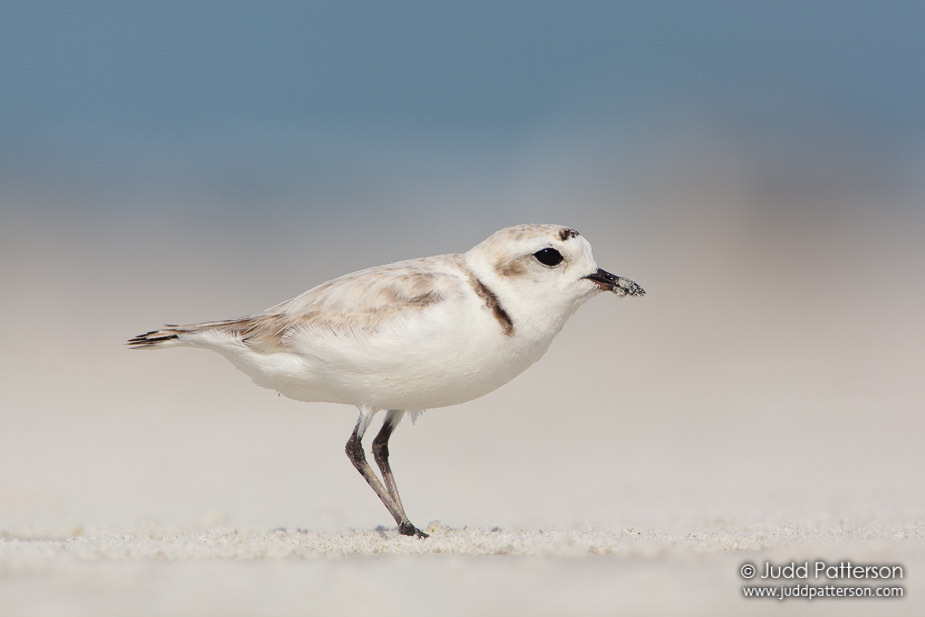
Snowy Plover
Anarhynchus nivosus
- Class
- Bird
- Rarity
- Rare
- Observations
- 11,217
- Most observed in
- 🇺🇸 United States
Description
The snowy plover (Anarhynchus nivosus, formerly Charadrius nivosus) is a small shorebird found in the Americas. It is a member of the bird family Charadriidae, which includes the plovers, dotterels, and lapwings. The snowy plover was originally described by John Cassin in 1858, but was classified as a subspecies of the Kentish plover in 1922. Since 2011, the snowy plover has been recognized as a distinct species based on genetic and anatomical differences from the Kentish plover. Two or three subspecies are recognized, distributed along the Pacific coast of North America, Ecuador, Peru, and Chile, in several inland areas of the US and Mexico, along the Gulf Coast, and on Caribbean islands. The coastal populations consist of both residential and migratory birds, whereas the inland populations are mostly migratory. It is one of the best studied endemic shorebirds of the Americas, and one of the rarest. Snowy plovers are pale brown above and white below, with a white band on the hind neck. During the breeding season, males have black patches behind the eye and on the side of the neck; the neck patches are separated from each other and do not form a continuous breast band as in many other plovers. Snowy plovers can also be distinguished from other plovers in having an all-black and slender bill, and gray to black legs. The typical call is a repeated "tu-wheet".
Summary adapted from the Wikipedia article “Snowy plover”.