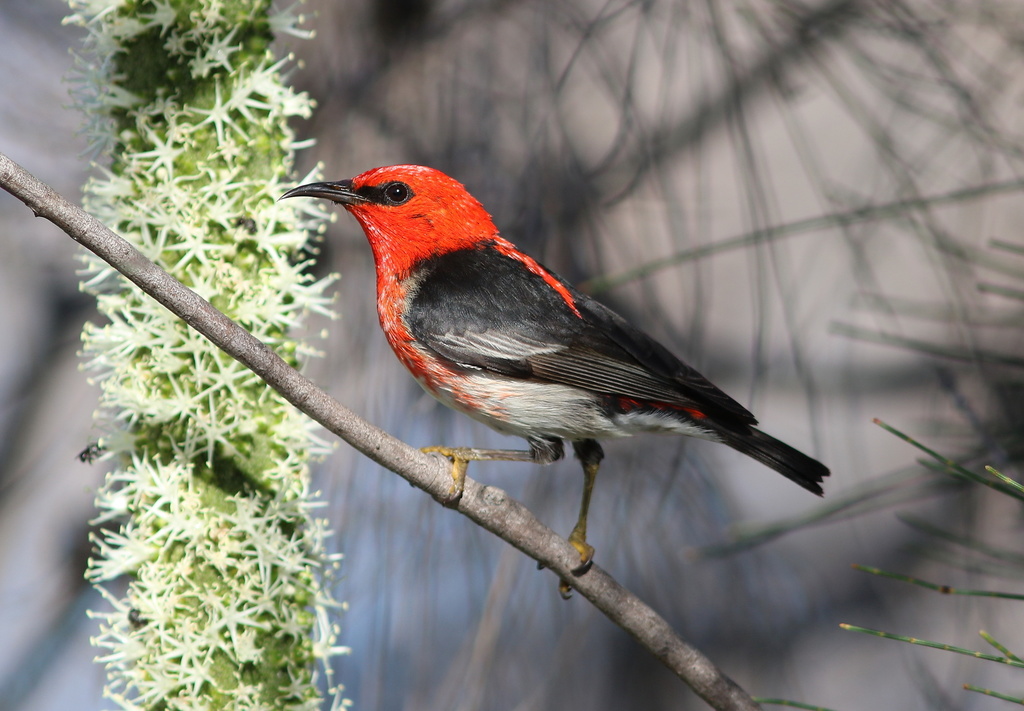
Scarlet Myzomela
Myzomela sanguinolenta
- Class
- Bird
- Rarity
- Common
- Observations
- 3,012
- Most observed in
- 🇦🇺 Australia
- Conservation
- Least Concern
Description
The scarlet myzomela or scarlet honeyeater (Myzomela sanguinolenta) is a small passerine bird of the honeyeater family Meliphagidae native to Australia. It was first described by English ornithologist John Latham in 1801. At 9 to 11 cm (3.5 to 4.3 in) long, it is the smallest honeyeater in Australia. It has a short tail and relatively long down-curved bill. It is sexually dimorphic; the male is a striking bright red with black wings, while the female is entirely brown. The species is more vocal than most honeyeaters, and a variety of calls have been recorded, including a bell-like tinkling. The scarlet myzomela is found along most of the eastern coastline, from Cape York in far north Queensland to Gippsland in Victoria. It is migratory in the southern parts of its range, with populations moving north in the winter. Its natural habitat is forest, where it forages mainly in the upper tree canopy. It is omnivorous, feeding on insects as well as nectar. Up to three broods may be raised over the course of a breeding season. The female lays two or rarely three flecked white eggs in a 5 cm (2 in) diameter cup-shaped nest high in a tree. The International Union for Conservation of Nature (IUCN) has assessed it as being of least concern on account of its large range and apparently stable population.
Summary adapted from the Wikipedia article “Scarlet myzomela”.