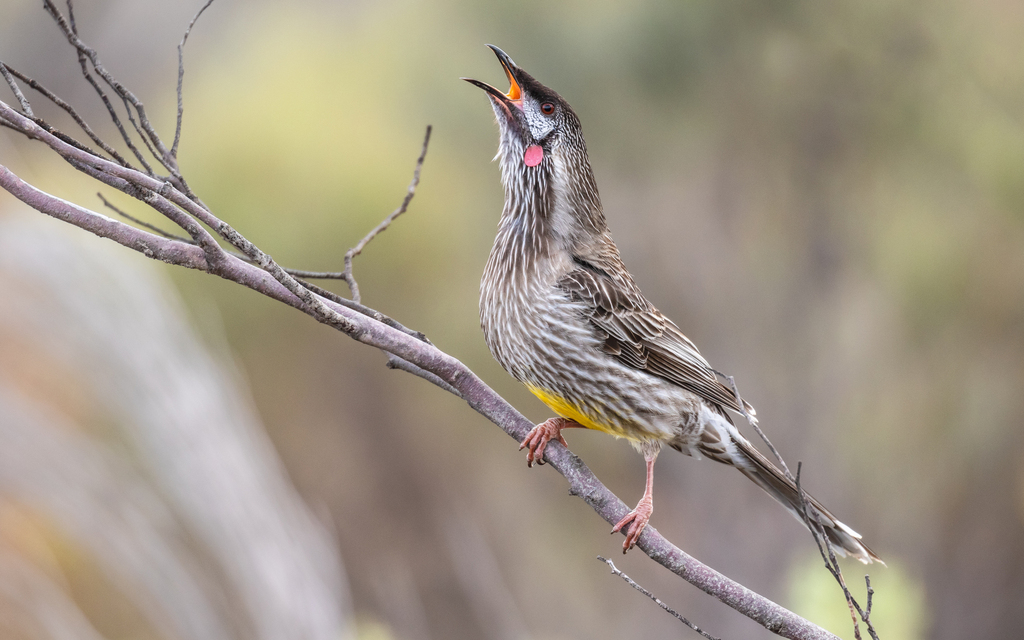
Red Wattlebird
Anthochaera carunculata
- Class
- Bird
- Rarity
- Common
- Observations
- 17,472
- Most observed in
- 🇦🇺 Australia
- Conservation
- Least Concern
Description
The red wattlebird (Anthochaera carunculata) is a passerine bird native to southern Australia. At 33–37 cm (13–14+1⁄2 in) in length, it is the second largest species of Australian honeyeater, after the yellow wattlebird. It has mainly grey-brown plumage, with red eyes, distinctive pinkish-red wattles on either side of the neck, white streaks on the chest and a large bright yellow patch on the lower belly. The sexes are similar in plumage. Juveniles have less prominent wattles and browner eyes. John White described the red wattlebird in 1790. Three subspecies are recognized. The species is found in southeast Queensland, New South Wales, Victoria, South Australia and southwest Western Australia in open forest and woodland, and is a common visitor to urban gardens and parks. Loud and conspicuous, the red wattlebird is generally found in trees, where it gets most of its food; occasionally it forages on the ground. It is one of the largest nectarivorous birds in the world, feeding from a wide variety of flowering plants. Insects also comprise part of its diet. It is territorial and at times aggressive towards birds of other species, often defending rich sources of nectar. Breeding throughout its range, the red wattlebird builds a cup-shaped nest in a tree and raises one or two broods a year. Although it has declined in places from land-clearing, it is classified as Least Concern on the IUCN Red List.
Summary adapted from the Wikipedia article “Red wattlebird”.