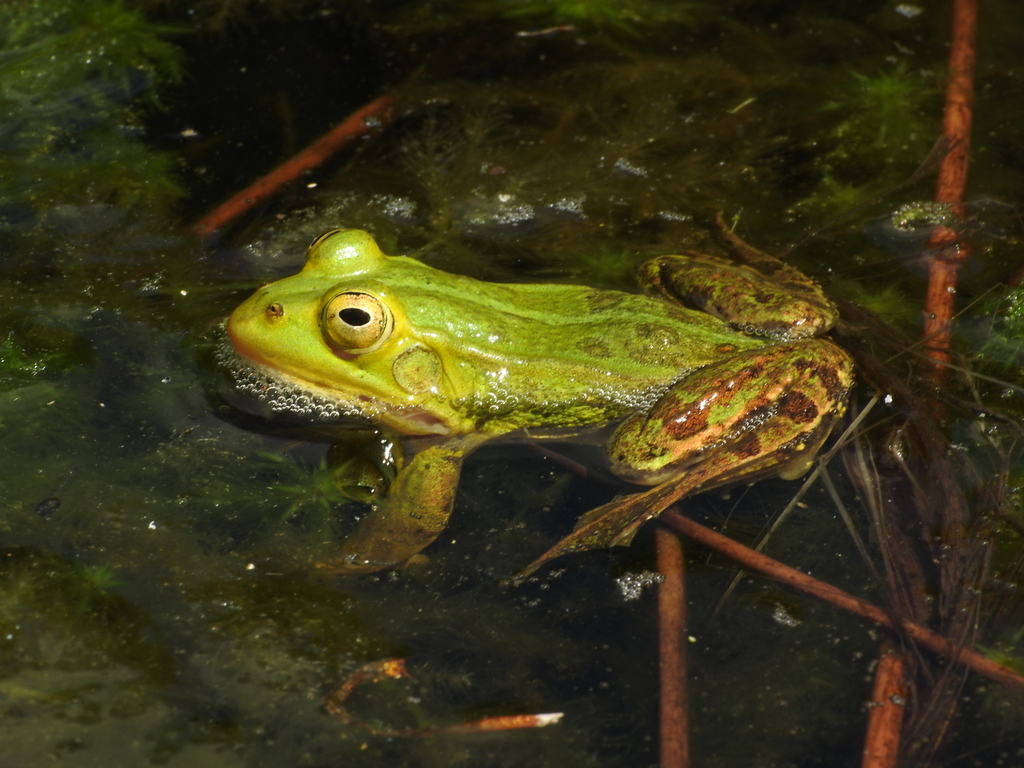
Pool Frog
Pelophylax lessonae
- Class
- Amphibian
- Rarity
- Common
- Observations
- 1,501
- Most observed in
- 🇷🇺 Russia
- Conservation
- Least Concern
Description
The pool frog (Pelophylax lessonae) is a species of frog in the family Ranidae. It is found in and around shallow, stagnant bodies of water across much of Europe, from France in the west to Russia in the east. Active in such areas from March to October, it disperses from the water to hibernate in woodland soil during the winter, and can tolerate being frozen overnight while hibernating. A close relative of the marsh frog, the two species can interbreed to produce a hybrid called the edible frog, which maintains its own population by breeding with one of its parental species. The pool frog is very similar in appearance to these related species, but can be distinguished based on vocal sac color, snout shape, leg length, the shape of a hardened lump on the foot, and skeletal features. Active during both day and night, the pool frog is a predator that feeds mainly on invertebrates as an adult, but begins its life as a tadpole with a herbivorous diet. The breeding season is in early summer, when males use vocalisations to ward one another off and attract females. The frogs are sensitive to changes in temperature, which determines their reproductive behaviour and calls. Mating and egg-laying occur in water, where the tadpoles develop until they metamorphose and emerge onto land in late summer. At all life stages, pool frogs are hunted by a wide range of predators such as fish, birds, snakes and otters, and are parasitized by trematode and nematode worms.
Summary adapted from the Wikipedia article “Pool frog”.