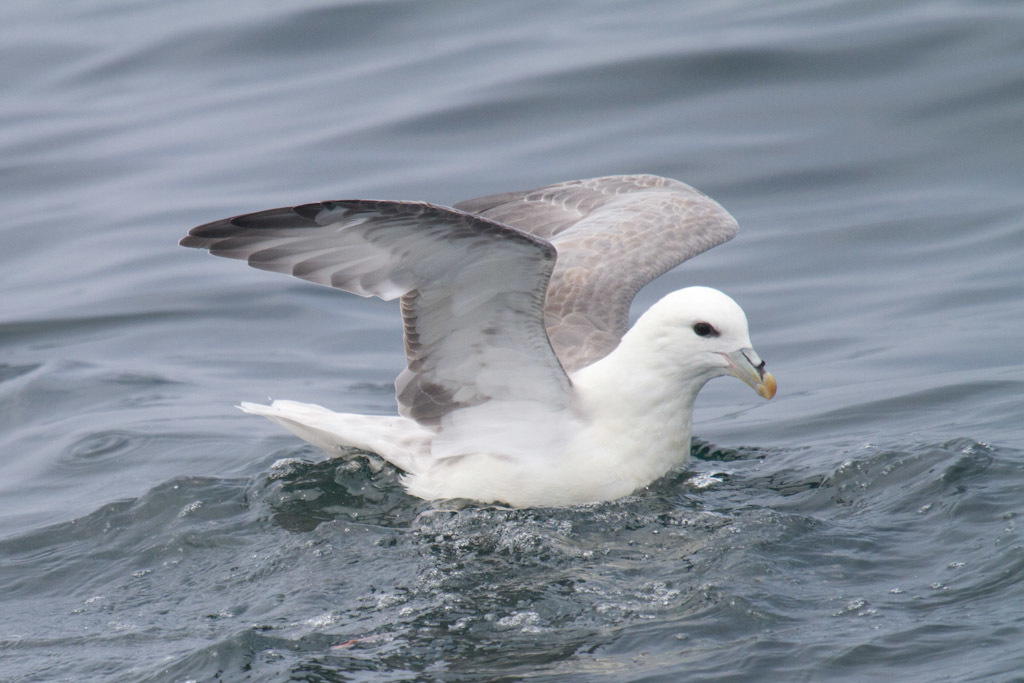
Northern Fulmar
Fulmarus glacialis
- Class
- Bird
- Rarity
- Common
- Observations
- 9,938
- Most observed in
- 🇬🇧 United Kingdom
- Conservation
- Least Concern
Description
The northern fulmar, Arctic fulmar, or simply fulmar (Fulmarus glacialis) is an abundant seabird found primarily in subarctic regions of the North Atlantic and North Pacific oceans. There has been one confirmed sighting in the Southern Hemisphere, with a single bird seen south of New Zealand. Fulmars come in one of two colour morphs; a light one in temperate populations, with white head and body and grey wings and tail, and a dark one in arctic populations, which is uniformly grey; intermediate birds are common. Though similar in appearance to gulls, fulmars are in fact members of the family Procellariidae, which includes petrels and shearwaters. The northern fulmar and its sister species, the southern fulmar (Fulmarus glacialoides), are the only extant members of the genus Fulmarus. The fulmars are in turn a member of the order Procellariiformes, and they all share certain identifying features. First, they have nasal passages that attach to the upper bill called naricorns; however, nostrils on albatrosses are on the sides of the bill, as opposed to the rest of the order, including fulmars, which have nostrils on top of the upper bill. The bills of Procellariiformes are also unique in that they are split into between seven and nine horny plates. One of these plates makes up the hooked portion of the upper bill, called the maxillary unguis. They produce a stomach oil made up of wax esters and triglycerides that is stored in the proventriculus.
Summary adapted from the Wikipedia article “Northern fulmar”.