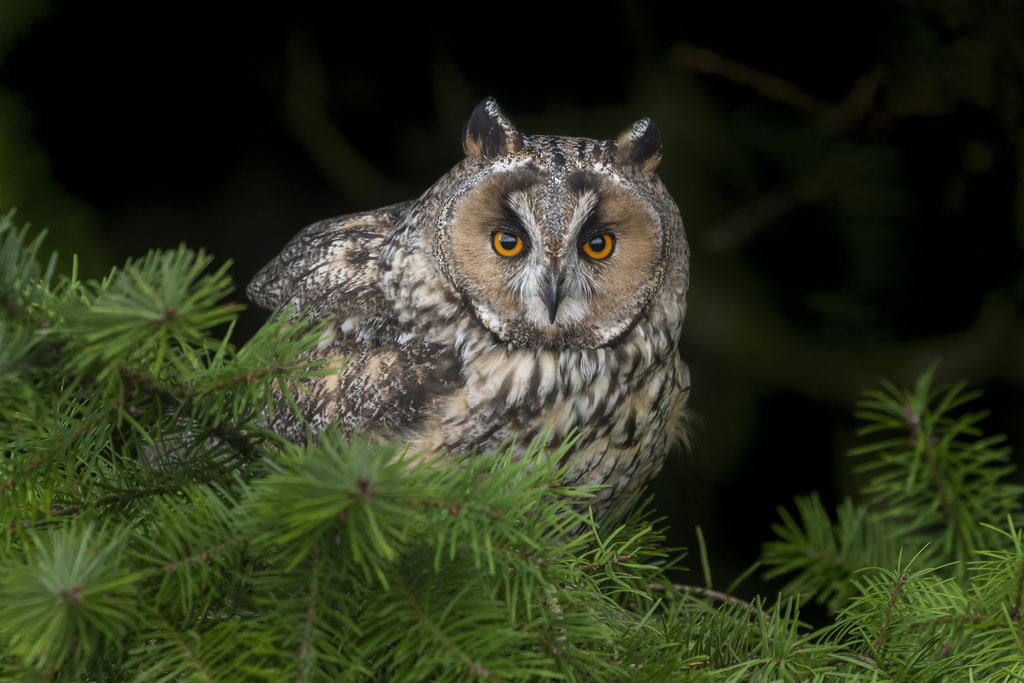
Long-eared Owl
Asio otus
- Class
- Bird
- Rarity
- Rare
- Observations
- 15,288
- Most observed in
- 🇷🇺 Russia
- Conservation
- Least Concern
Description
The long-eared owl (Asio otus), also known as the northern long-eared owl or, more informally, as the lesser horned owl or cat owl, is a medium-sized species of owl with an extensive breeding range. The genus name, Asio, is Latin for "horned owl", and the specific epithet, otus, is derived from Greek and refers to a small eared owl. The species breeds in Europe and the Palearctic, as well as in North America. This species is a part of the larger grouping of owls known as typical owls, of the family Strigidae, which contains most extant species of owl. This owl prefers semi-open habitats, particularly woodland edge, as they to roost and nest within dense stands of wood but prefer to hunt over open ground. The long-eared owl is a specialized predator, focusing its diet on small rodents, especially voles. Under some circumstances, such as population cycles of their regular prey, arid or insular regional habitats or urbanization, this species can adapt to a diversity of prey, including birds and insects. The long-eared owl utilizes nests built by other animals, in particular by corvids. Breeding success in this species is correlated with prey populations and predation risks. Unlike many owls, long-eared owls are not strongly territorial or sedentary. They are partially migratory and sometimes characterized as "nomadic". Another characteristic of this species is its partiality for regular roosts shared by a number of long-eared owls at once.
Summary adapted from the Wikipedia article “Long-eared owl”.