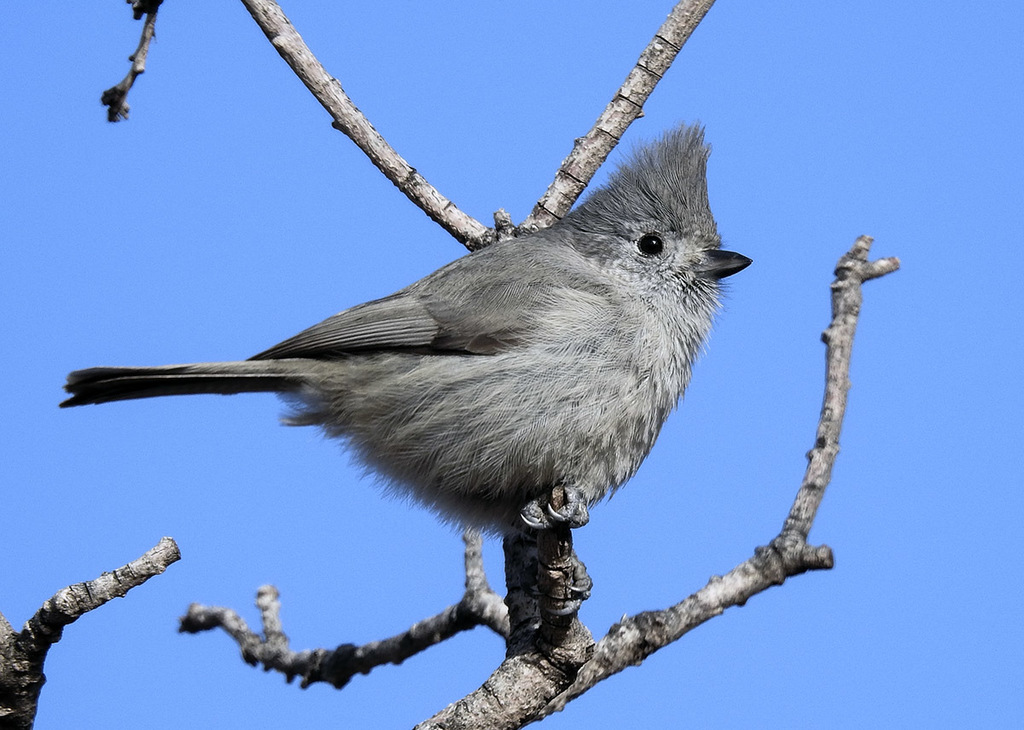
Juniper Titmouse
Baeolophus ridgwayi
- Class
- Bird
- Rarity
- Common
- Observations
- 1,603
- Most observed in
- 🇺🇸 United States
- Conservation
- Least Concern
Description
The juniper titmouse (Baeolophus ridgwayi) is a passerine bird in the tit family Paridae. The American Ornithologists' Union split the plain titmouse into the oak titmouse and the juniper titmouse in 1996, due to distinct differences in song, preferred habitat, and genetic makeup. The juniper titmouse is a small, gray bird with small tuft or crest. Male and female are visually similar. This titmouse lives year-round primarily in the Great Basin, but is resident from southeastern Oregon and central Colorado south to the eastern Mojave Desert in California and central Arizona, as far as west Texas and extreme northeastern Sonora, Mexico-(the Madrean sky islands). It prefers open woodlands of warm, dry pinyon-juniper, juniper and desert riparian woods. Juniper titmice will sleep in cavities, dense foliage, or birdhouses. When roosting in foliage, the titmouse chooses a twig surrounded by dense foliage or an accumulation of dead pine needles, simulating a roost in a cavity. It forms pairs or small groups, but does not form large flocks. It may join mixed-species flocks after breeding season for foraging. The juniper titmouse eats insects and spiders, sometimes seen catching insects in mid air. It also eats berries, acorns, and some seeds, sometimes hammering seeds against branches to open them. The bird forages on foliage, twigs, branches, trunks, and occasionally on the ground. Strong legs and feet allows it to hang upside down to forage.
Summary adapted from the Wikipedia article “Juniper titmouse”.