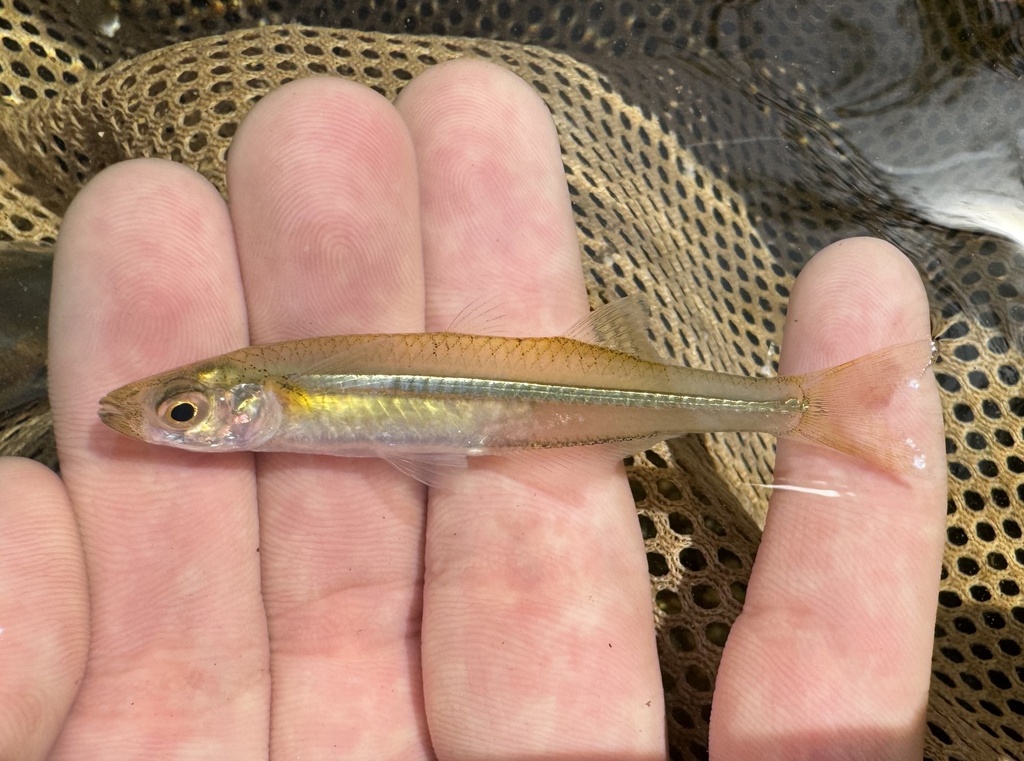
Inland Silverside
Menidia beryllina
- Class
- Ray-finned fish
- Rarity
- Common
- Observations
- 509
- Most observed in
- 🇺🇸 United States
- Conservation
- Least Concern
Description
The inland silverside (Menidia beryllina) is a neotropical silverside native to eastern North America, and introduced into California. It is a fish of estuaries and freshwater environments. Inland silversides are quite elongate even for silverside, with lengths six to seven times depth. They have large eyes, a considerably upturned mouth, and a head noticeably flattened on top. Of the two widely separated dorsal fins, the anterior fin is small and has four to five weak spines, while the posterior fin is larger, with one spine and eight or nine rays. The lengthy anal fin is somewhat sickle-shaped, has one spine and 16 to 18 rays. As befits the name, they are silvery on the sides; the back is somewhat yellow, and the underside is a translucent green. These are small fish, with 15 cm recorded, but most adults 10 cm or less. They primarily feed on zooplankton, moving in enormous schools capable of depleting populations of the small arthropods and crustaceans they favor. In turn, they are prey for a variety of fish and birds. The silversides congregate in the shallows, generally over sand or gravel bottoms with overhead cover if possible, but then move out to open water in search of additional food, which increases predation risk. They are often observed in a sort of daily migration pattern as a result. The exact native range of the inland silverside is not known; they are widespread along the Atlantic coast from Maine to Florida, and along the Gulf of Mexico.
Summary adapted from the Wikipedia article “Inland silverside”.