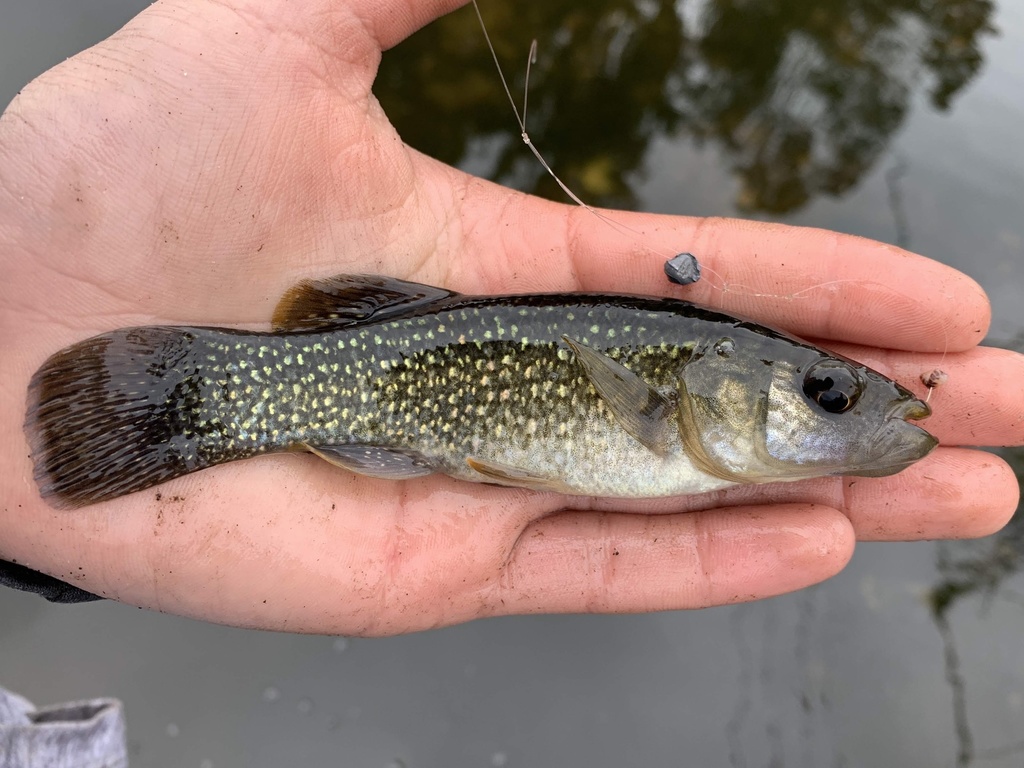
Gulf Killifish
Fundulus grandis
- Class
- Ray-finned fish
- Rarity
- Common
- Observations
- 865
- Most observed in
- 🇺🇸 United States
- Conservation
- Least Concern
Description
The Gulf killifish (Fundulus grandis) is one of the largest members of the genus Fundulus; it is capable of growing up to 7 inches (18 cm) in length, whereas the majority of other Fundulus reach a maximum length of 4 inches (10 cm). Therefore, F. grandis is among the largest minnows preyed upon by many sport fish, such as flounder, speckled trout (Cynoscion nebulosus), and red drum (Sciaenops ocellatus). Fundulus derives from the Latin meaning "bottom," and grandis means "large". The Gulf killifish is native to the Gulf of Mexico from Texas to Florida and the eastern coast of Florida and the Caribbean Sea in the Atlantic Ocean. Threats to the survival of the Gulf killifish include extreme changes in salinity, changes in temperatures, and toxic events such as the hypoxic dead zone in Louisiana and the Deepwater Horizon oil spill. The Gulf killifish is currently being used to test the effects of oil and oil dispersants on the physiology of marine species affected by these substances. This is significant to conservation biology, because with the continued extraction of oil and other natural resources from North American waters, it has become increasingly important to understand the risks and consequences in worst-case scenarios, such as the Deepwater Horizon oil spill, and the lasting effects on the marine ecosystem.
Summary adapted from the Wikipedia article “Gulf killifish”.