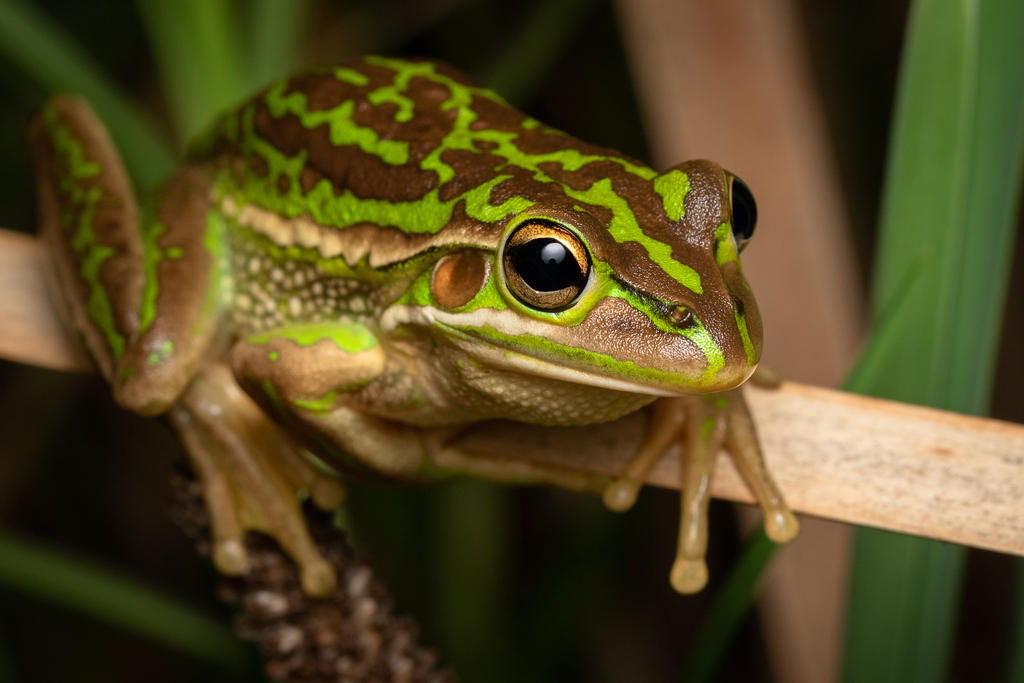
Green and Golden Bell Frog
Ranoidea aurea
- Class
- Amphibian
- Rarity
- Common
- Observations
- 1,274
- Most observed in
- 🇳🇿 New Zealand
Description
The green and golden bell frog (Ranoidea aurea), also named the green bell frog, green and golden swamp frog and green frog, is a species of ground-dwelling tree frog native to eastern Australia. Despite its classification and climbing abilities, it does not live in trees and spends almost all of its time close to ground level. It can reach up to 11 cm (4.5 in) in length, making it one of Australia's largest frogs. Coloured gold and green, the frogs are voracious eaters of insects, but will also eat larger prey, such as worms and mice. They are mainly diurnal, although this is mostly to warm in the sun. They tend to be less active in winter except in warmer or wetter periods, and breed in the warmer months. Males reach maturity after around 9 months, while for the larger females, this does not occur until they are two years old. The frogs can engage in cannibalism, and males frequently attack and injure one another if they infringe on one another's space. Many populations, particularly in the Sydney region, inhabit areas of infrequent disturbance, such as golf courses, disused industrial land, brick pits, and landfill areas. Though once one of the most common frogs in south-east Australia, the green and golden bell frog has endured major population declines, particularly in highland areas, leading to its current classification as globally endangered.
Summary adapted from the Wikipedia article “Green and golden bell frog”.