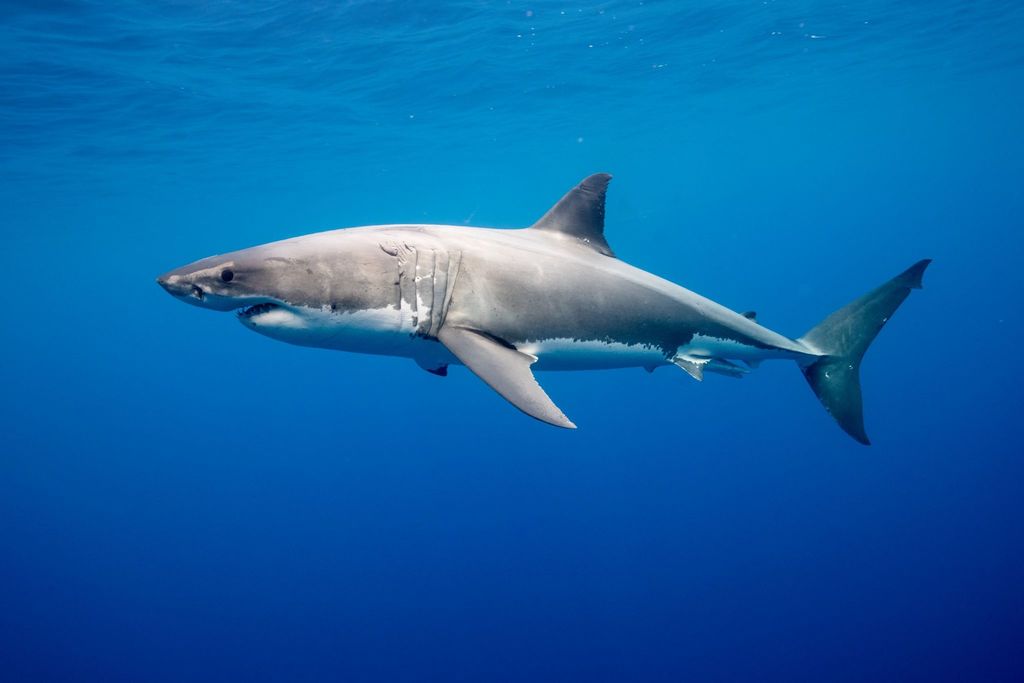
Great White Shark
Carcharodon carcharias
- Class
- Cartilaginous fish
- Rarity
- Rare
- Observations
- 733
- Most observed in
- 🇺🇸 United States
- Conservation
- Vulnerable
Description
The great white shark (Carcharodon carcharias), also known as the white shark, white pointer, or great white, is a large shark. It is closely related to the mako sharks, the porbeagle, and the salmon shark. It is a robustly built species with a grayish upperside and a white underside. The white shark is one of the largest living shark and fish species, though it is still smaller than the whale shark and basking shark. It has about 300 triangular, serrated teeth that are continuously replaced. Its massive, fatty liver can reach over a quarter of its body weight, providing buoyancy and storing energy. The species is partially warm-blooded, an adaptation that allows it to remain active in colder waters. White sharks inhabit tropical and temperate ocean waters around the world and can be found both near coasts and in the open ocean. Populations are most concentrated at the Pacific and Atlantic of North America and in the waters of southern Africa and Oceania. They are a highly migratory species, traveling between the coast and the open ocean and even between continents. The white shark preys on marine mammals such as seals and dolphins, as well as squid and fish, including other sharks. It also scavenges whale carcasses. Though normally an apex predator, the species is sometimes preyed on by orcas. White sharks are generally solitary, but may gather in aggregations, particularly at feeding sites. They may communicate and establish dominance hierarchies with body language.
Summary adapted from the Wikipedia article “Great white shark”.