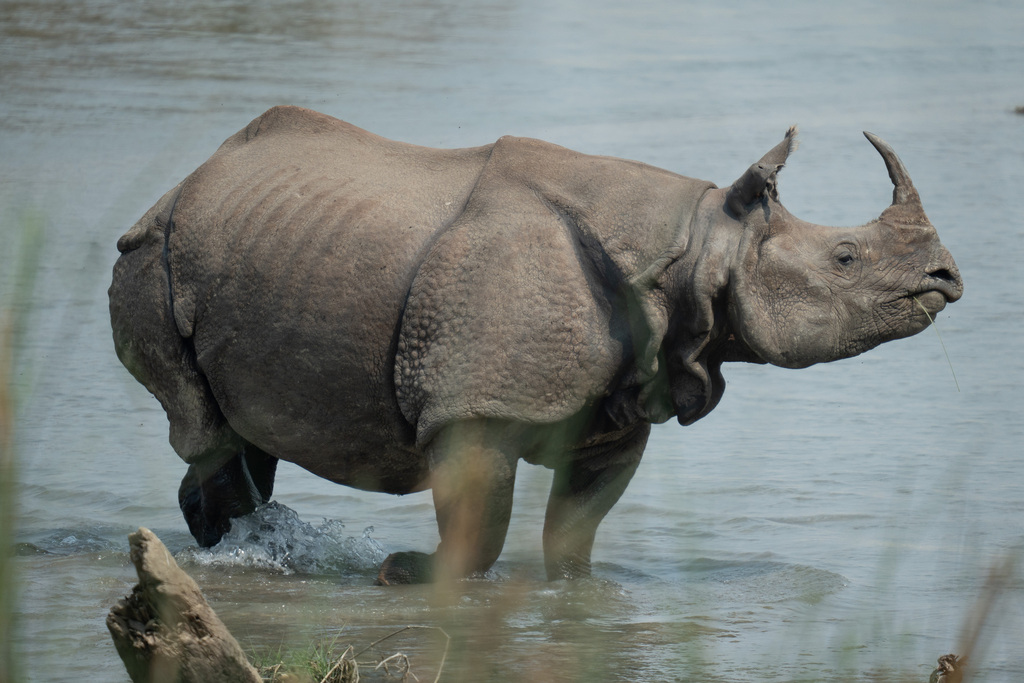
Great Indian Rhinoceros
Rhinoceros unicornis
- Class
- Mammal
- Rarity
- Epic
- Observations
- 1,213
- Most observed in
- 🇳🇵 Nepal
- Conservation
- Vulnerable
Description
The Indian rhinoceros (Rhinoceros unicornis), also known as the greater one-horned rhinoceros, great Indian rhinoceros or Indian rhino, is a rhinoceros species native to the Indian subcontinent. It is the second largest living rhinoceros and the largest in Asia, with adult males weighing 2.07–2.2 t (2.04–2.17 long tons; 2.28–2.43 short tons) and adult females 1.6 t (1.6 long tons; 1.8 short tons). Its thick skin is grey-brown with pinkish skin folds. It has a single horn on its snout that grows up to 57.2–61.6 cm (22.5–24.3 in) long. Its upper legs and shoulders are covered in wart-like bumps, and it is nearly hairless aside from the eyelashes, ear fringes and tail brush. The Indian rhinoceros occurs in the Indo-Gangetic Plain in 12 protected areas in northern India and southern Nepal. It is a grazer, eating mainly grass, but also twigs, leaves, branches, shrubs, flowers, fruits and aquatic plants. It is a largely solitary animal, only associating in the breeding season and when rearing calves. Females give birth to a single calf after a gestation of 15.7 months. The birth interval is 34–51 months. Captive individuals can live up to 47 years. It is susceptible to diseases such as anthrax, and those caused by parasites such as leeches, ticks and nematodes. The Indian rhinoceros is listed as Vulnerable on the IUCN Red List, as the population is fragmented and restricted to less than 20,000 km2 (7,700 sq mi).
Summary adapted from the Wikipedia article “Indian rhinoceros”.