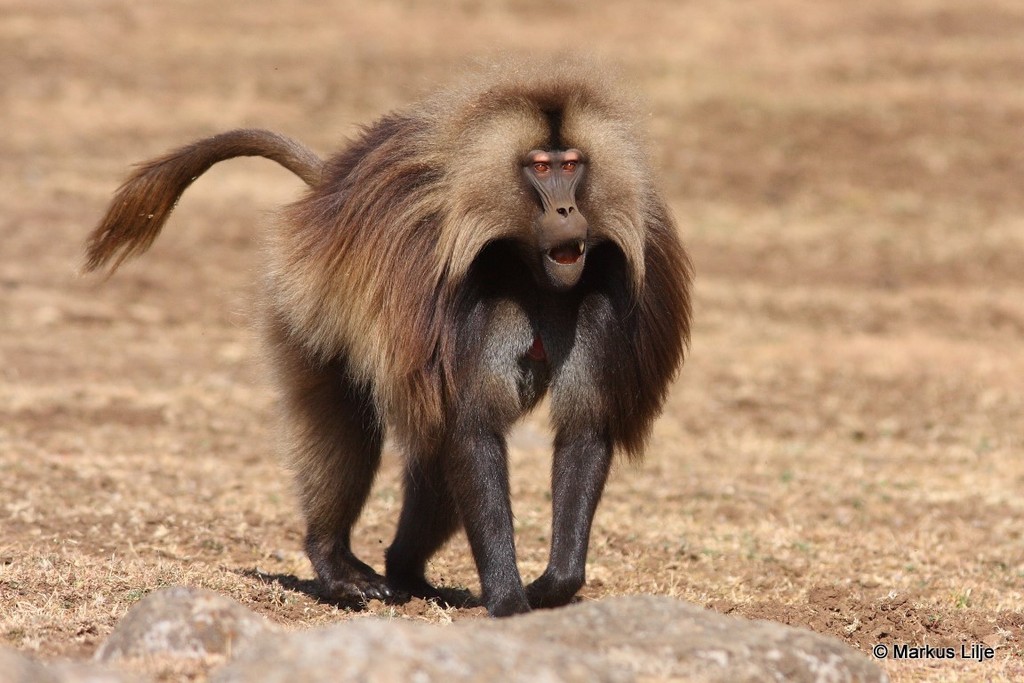
Gelada Baboon
Theropithecus gelada
- Class
- Mammal
- Rarity
- Common
- Observations
- 219
- Most observed in
- 🇪🇹 Ethiopia
- Conservation
- Least Concern
Description
The gelada (Theropithecus gelada, Amharic: ጭላዳ, romanized: č̣əlada, Oromo: Jaldeessa daabee), sometimes called the bleeding-heart monkey or the gelada baboon, is a species of Old World monkey found only in the Ethiopian Highlands, living at elevations of 1,800–4,400 m (5,900–14,400 ft) above sea level. It is the only living member of the genus Theropithecus, a name derived from the Greek root words for "beast-ape" (θηρο-πίθηκος : thēro-píthēkos). Like its close relatives in genus Papio, the baboons, it is largely terrestrial, spending much of its time foraging in grasslands, with grasses comprising up to 90% of its diet. It has buff to dark brown hair with a dark face and pale eyelids. Adult males have longer hair on their backs and a conspicuous bright red patch of skin shaped like an hourglass on their chests. Females also have a bare patch of skin but it is less pronounced, except during estrus, when it brightens and exhibits a "necklace" of fluid-filled blisters. Males average 18.5 kg (41 lb) and females average 11 kg (24 lb) in weight. The head-body length is 50–75 cm (20–30 in) with a tail of 30–50 cm (12–20 in). The gelada has a complex multilevel social structure. Reproductive units and male units are the two basic groupings. A band comprises a mix of multiple reproductive units and male units; a community is made up of one to four bands. Within the reproductive units the females are commonly closely related.
Summary adapted from the Wikipedia article “Gelada”.