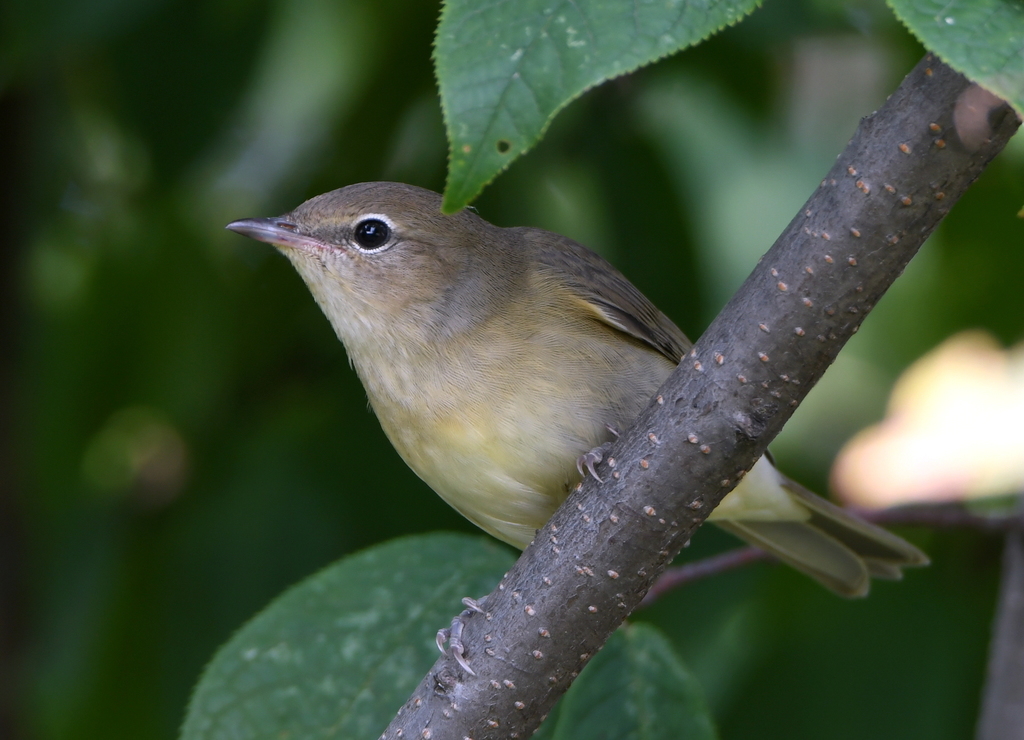
Garden Warbler
Sylvia borin
- Class
- Bird
- Rarity
- Common
- Observations
- 5,754
- Most observed in
- 🇷🇺 Russia
- Conservation
- Least Concern
Description
The garden warbler (Sylvia borin) is a common and widespread small bird that breeds in most of Europe and in the Palearctic to western Siberia. It is a plain, long-winged and long-tailed warbler with brown upperparts and dull white underparts; the sexes are similar and juveniles resemble the adults. Its two subspecies differ only slightly and interbreed where their ranges overlap. Due to its lack of distinguishing features, this species can be confused with a number of other unstreaked warblers. The garden warbler's rich melodic song is similar to that of the blackcap, its closest relative, which competes with it for territory when nesting in the same woodland. The preferred breeding habitat in Eurasia is open woodland with dense low cover for nesting; despite its name, gardens are rarely occupied by this small passerine bird. The clutch of four or five blotched cream or white eggs is laid in a robust cup-shaped nest built near the ground and concealed by dense vegetation. The eggs are incubated for 11–12 days. The chicks are altricial, hatching naked and with closed eyes, and are fed by both parents. They fledge about 10 days after hatching. Only about a quarter of young birds survive their first year. The garden warbler is strongly migratory, wintering in sub-Saharan Africa. A wide range of habitats are used in Africa, but closed forest and treeless Sahel are both shunned.
Summary adapted from the Wikipedia article “Garden warbler”.