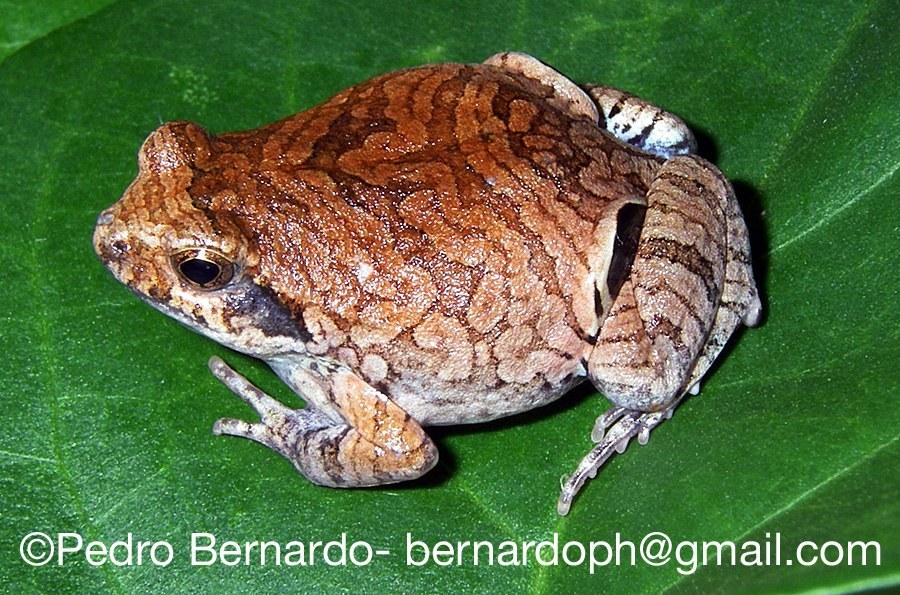
Cuyaba Dwarf Frog
Physalaemus nattereri
- Class
- Amphibian
- Rarity
- Common
- Observations
- 267
- Most observed in
- 🇧🇷 Brazil
- Conservation
- Least Concern
Description
Physalaemus nattereri (common name: Cuyaba dwarf frog) is a frog native to central and southeastern Brazil and eastern Bolivia and Paraguay. It inhabits savanna and Cerrado regions, always near permanent or temporary water bodies such as ponds and swamps, where it typically nests. The species is not adapted to areas with human activity. Males have an average length of 4.7 centimeters (1.9 in), while females measure 4.9 centimeters (1.9 in). The dorsal coloration ranges from light brown to dark brown or reddish, featuring a mosaic of darker spots or stripes. The ventral surface is light brown with dark spots. The species is unmistakable in its habitat due to a pair of ocelli on the posterior part of its body. Its testicles and other organs are brightly colored, a rare trait among anurans, caused by a high concentration of melanocytes. Its diet is generalist and opportunistic, primarily consisting of termites and ants. Despite an effective defense strategy and highly potent toxins, it can be preyed upon by various animals, including birds and beetles. Its primary predators are giant water bugs, which often attack during reproduction and metamorphosis. One defense mechanism is deimatic behaviour, where the frog inflates its lungs, lowers its head, and raises its posterior, displaying its ocelli to startle predators, appearing as a larger animal facing them.
Summary adapted from the Wikipedia article “Physalaemus nattereri”.