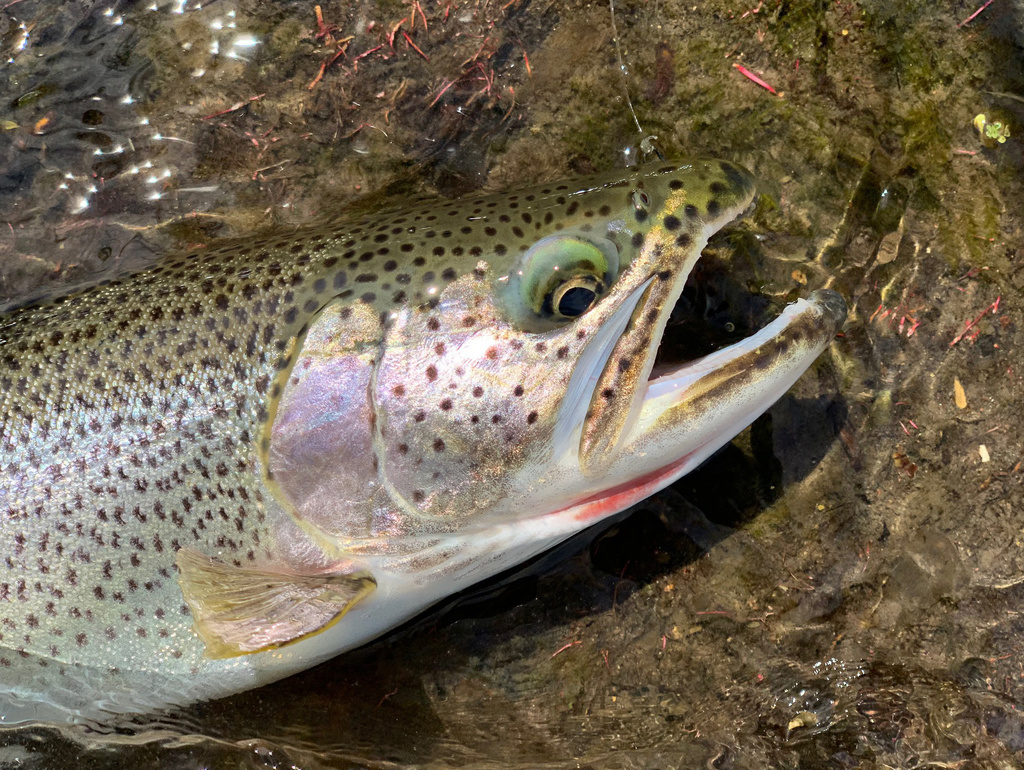
Cutthroat Trout
Oncorhynchus clarkii
- Class
- Ray-finned fish
- Rarity
- Rare
- Observations
- 1,349
- Most observed in
- 🇺🇸 United States
- Conservation
- Least Concern
Description
The cutthroat trout (Oncorhynchus clarkii clade) is a clade of four fish species of the family Salmonidae native to cold-water tributaries of the Pacific Ocean, Rocky Mountains, and Great Basin in North America. These four species are the Coastal (O. clarkii), Westslope (O. lewisi), Lahontan (O. henshawi), and the Rocky Mountain (O. virginalis). As a member of the genus Oncorhynchus, it is in the Pacific trout group, which includes the widely distributed rainbow trout. Cutthroat trout are popular gamefish, especially among anglers who enjoy fly fishing. The common name "cutthroat" refers to the distinctive red coloration on the underside of the lower jaw. The specific name clarkii was given to honor explorer William Clark, coleader of the Lewis and Clark Expedition. Cutthroat trout usually inhabit and spawn in small to moderately large, clear, well-oxygenated, shallow rivers with gravel bottoms. They reproduce in clear, cold, moderately deep lakes. They are native to the alluvial or freestone streams that are typical tributaries of the rivers of the Pacific Basin, Great Basin and Rocky Mountains. Cutthroat trout spawn in the spring and may inadvertently but naturally hybridize with rainbow trout, producing fertile cutbows. Some populations of the coastal cutthroat trout (O. c. clarkii) are semi-anadromous. Several subspecies of cutthroat trout are currently listed as threatened in their native ranges due to habitat loss and the introduction of non-native species.
Summary adapted from the Wikipedia article “Cutthroat trout”.