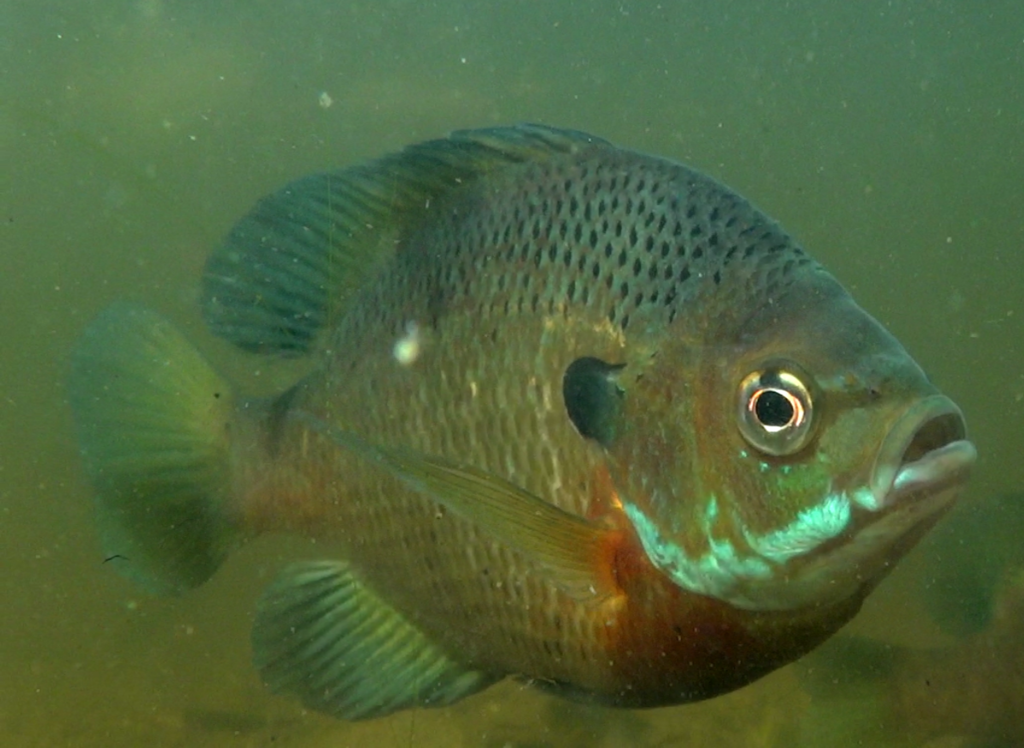
Bluegill
Lepomis macrochirus
- Class
- Ray-finned fish
- Rarity
- Common
- Observations
- 41,364
- Most observed in
- 🇺🇸 United States
- Conservation
- Least Concern
Description
The bluegill (Lepomis macrochirus), sometimes referred to as "bream", "brim", "sunny", or, in Texas, "copper nose", is a species of North American freshwater fish, native to and commonly found in streams, rivers, lakes, ponds and wetlands east of the Rocky Mountains. It is from the family Centrarchidae (sunfishes, crappies and black basses) in the order Centrarchiformes. Bluegills can grow up to 16 in (41 cm) long and about 4+1⁄2 lb (2.0 kg). While their color can vary from population to population, they typically have a very distinctive coloring, with deep blue and purple on the face and gill cover, dark olive-colored bands down the side, and a fiery orange to yellow belly. They are omnivorous and will consume anything they can fit in their mouth, but mostly feed on small aquatic insects and baitfishes. The fish are important prey for bass, other larger sunfish, northern pike and muskellunge, walleye, trout, herons, kingfishers, snapping turtles and otters, and play a key role within the food chain of its freshwater ecosystem. A popular panfish among anglers, bluegill usually hide around and inside old tree stumps in swamps and other underwater structures (e.g. snags), and can live in either deep or very shallow water. Bluegills also like to find shelter among aquatic plants and in the shade of trees along banks, and will often move from one cover to another depending on the time of day or season.
Summary adapted from the Wikipedia article “Bluegill”.