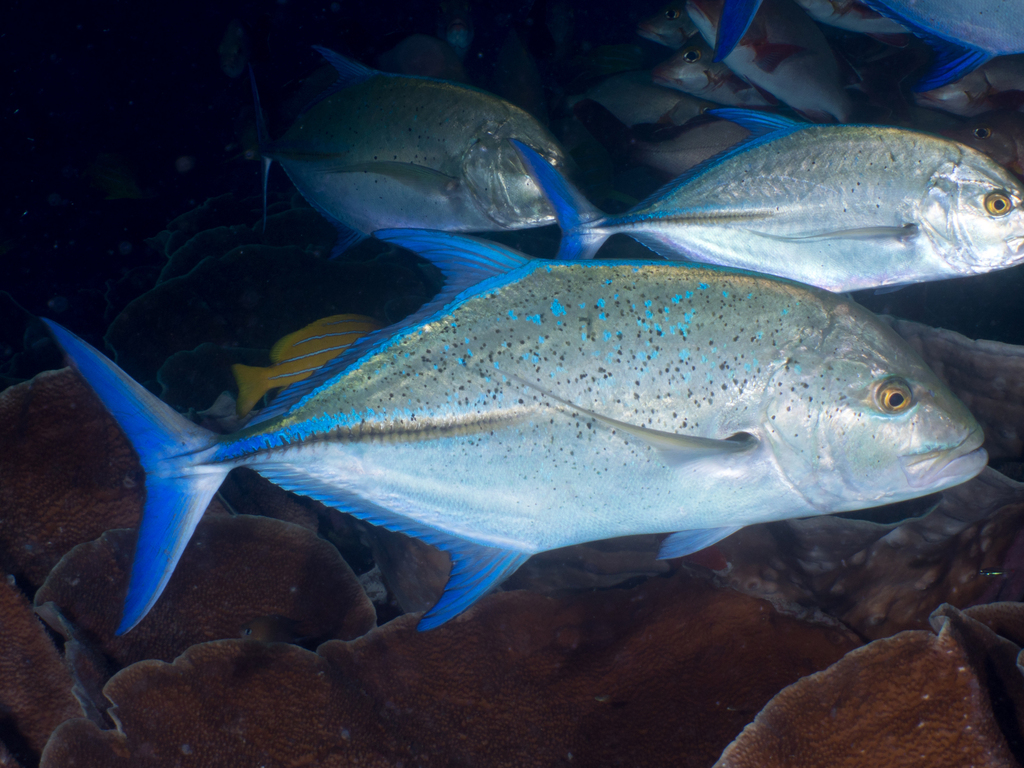
Bluefin Trevally
Caranx melampygus
- Class
- Ray-finned fish
- Rarity
- Common
- Observations
- 3,585
- Most observed in
- 🇺🇸 United States
- Conservation
- Least Concern
Description
The bluefin trevally (Caranx melampygus), also known as the bluefin jack, bluefin kingfish, bluefinned crevalle, blue ulua, omilu, and spotted trevally, is a species of large, widely distributed marine fish classified in the jack family, Carangidae. The bluefin trevally is distributed throughout the tropical waters of the Indian and Pacific Oceans, ranging from Eastern Africa in the west to Central America in the east, including Japan in the north and Australia in the south. The species grows to a maximum known length of 117 centimetres (46 in) and a weight of 43.5 kilograms (96 lb), however is rare above 80 centimetres (31 in). Bluefin trevally are easily recognised by their electric blue fins, tapered snout and numerous blue and black spots on their sides. Juveniles lack these obvious colours, and must be identified by more detailed anatomical features such as fin ray and scute counts. The bluefin trevally inhabits both inshore environments such as bays, lagoons and shallow reefs, as well as deeper offshore reefs, atolls and bomboras. Juveniles prefer shallower, protected waters, even entering estuaries for short periods in some locations. The bluefin trevally is a strong predatory fish, with a diet dominated by fish and supplemented by cephalopods and crustaceans as an adult. Juveniles consume a higher amount of small crustaceans, but transfer to a more fish based diet as they grow.
Summary adapted from the Wikipedia article “Bluefin trevally”.