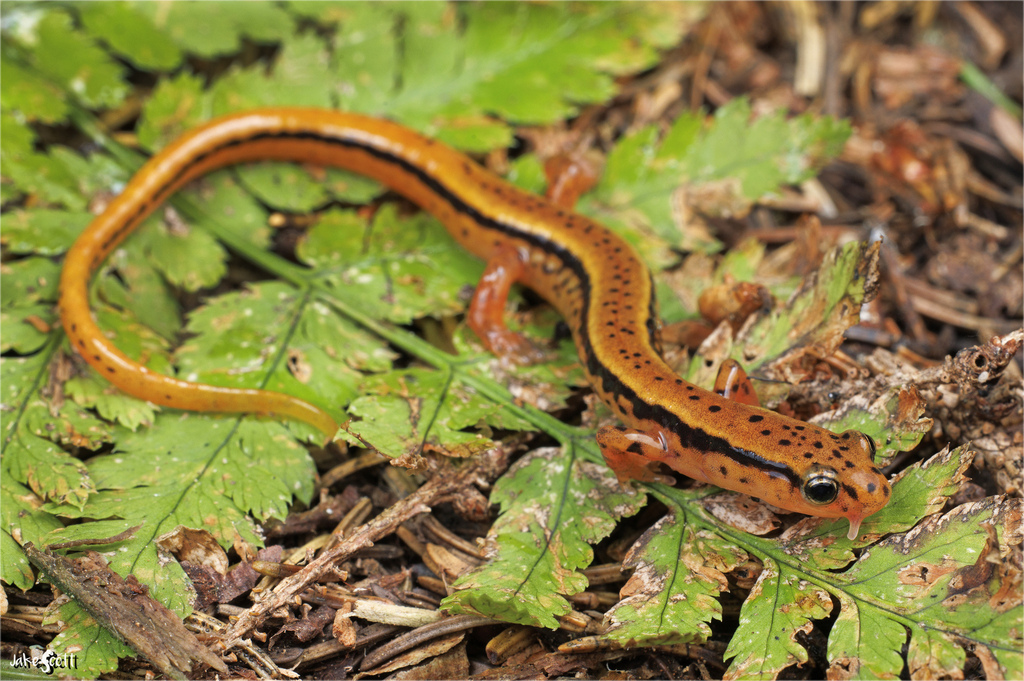
Blue Ridge Two-lined Salamander
Eurycea wilderae
- Class
- Amphibian
- Rarity
- Common
- Observations
- 2,418
- Most observed in
- 🇺🇸 United States
- Conservation
- Least Concern
Description
The Blue Ridge two-lined salamander (Eurycea wilderae) is a species of salamander in the family Plethodontidae, endemic to the United States. This species is found in the southern Appalachian Mountains, mostly south of Virginia. To the north is a similar salamander, Eurycea bislineata, or the northern two-lined salamander. Its genus, Eurycea contains 33 species and includes taxa that have either a metamorphic life cycle or larval-form paedomorphosis. In species that metamorphose, there can be within-and among-population variation in larval life-history characteristics, e.g., duration of the larval period and size at metamorphosis. Intraspecific geographic variation in species of Eurycea has been attributed to several factors: temperature, stream order and productivity of the larval habitat. Adult Blue Ridge two-lined salamanders are commonly found near stream banks. The larvae are aquatic, living in streams and seeps. Its natural habitats are temperate forests, rivers, intermittent rivers, and freshwater springs. It is threatened by habitat loss. This species is named after zoologist Inez Whipple Wilder, who studied biology of Eurycea species. These amphibians are listed by the IUCN as a species of least concern for conservation.
Summary adapted from the Wikipedia article “Blue Ridge two-lined salamander”.