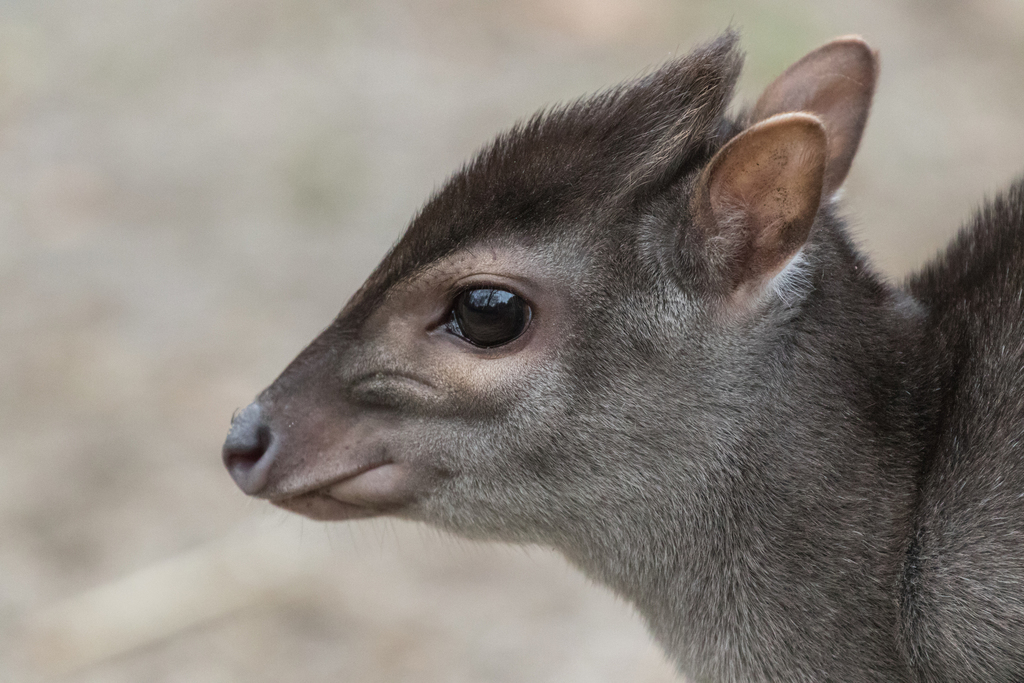
Blue Duiker
Philantomba monticola
- Class
- Mammal
- Rarity
- Common
- Observations
- 835
- Most observed in
- 🇨🇫 Central African Republic
- Conservation
- Least Concern
Description
The blue duiker (Philantomba monticola) is a small antelope found in central, southern and eastern Africa. It is the smallest species of duiker. The species was first described by Swedish naturalist Carl Peter Thunberg in 1789. 12 subspecies are identified. The blue duiker reaches 32–41 centimetres (13–16 in) at the shoulder and weighs 3.5–9 kilograms (7.7–19.8 lb). Sexually dimorphic, the females are slightly larger than the males. The dark tail measures slightly above 10 centimetres (3.9 in). It has short, spiky horns, around 5 centimetres (2.0 in) long and hidden in hair tufts. The subspecies show a great degree of variation in their colouration. The blue duiker bears a significant resemblance to Maxwell's duiker. Activity is diurnal (limited to daytime). Secretive and cautious, the blue duiker confines itself to the forest fringes. Territorial, individuals of opposite sexes form pairs and occupy territories, nearly 0.4–0.8 hectares (0.0015–0.0031 sq mi) large and marked by preorbital gland secretions. The blue duiker feeds on fallen fruits, foliage, flowers and pieces of bark, provided mainly by the forest canopies in their habitat. The age when sexual maturity is gained has been given differently by different studies. The species is monogamous, with pairs remaining together throughout the year. The length of the gestational period has been estimated from as little as four months to as long as seven months.
Summary adapted from the Wikipedia article “Blue duiker”.