Black Wildebeest
Connochaetes gnou
- Class
- Mammal
- Rarity
- Common
- Observations
- 905
- Most observed in
- 🇿🇦 South Africa
- Conservation
- Least Concern
Description
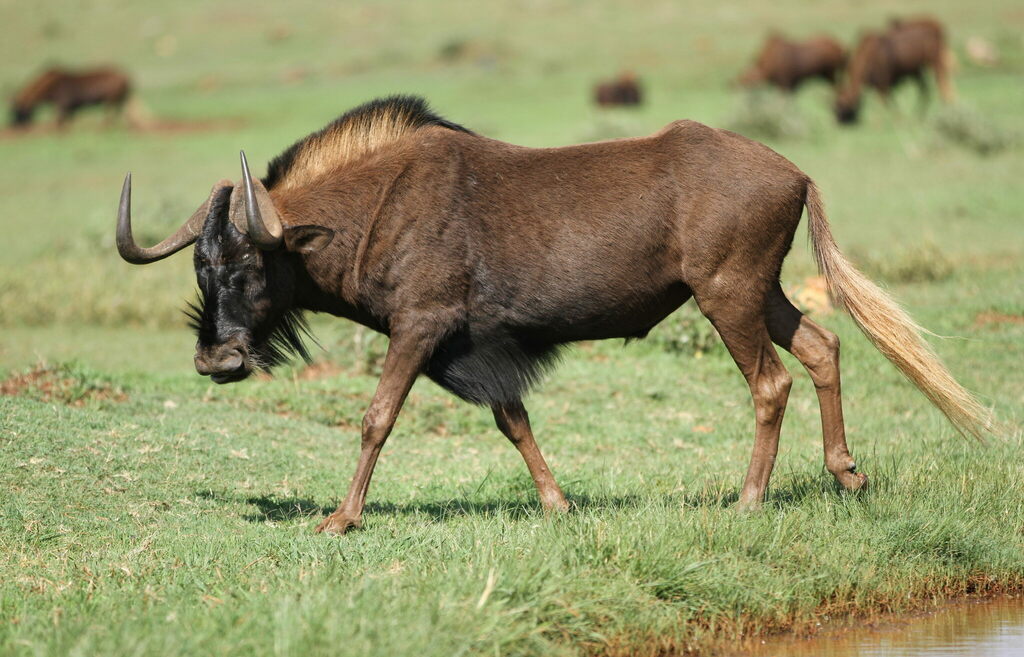
The black wildebeest or white-tailed gnu (Connochaetes gnou) is one of the two closely related wildebeest species. It is a member of the genus Connochaetes and family Bovidae. It was first described in 1780 by Eberhard August Wilhelm von Zimmermann. The black wildebeest is typically 1.7–2.2 m (5 ft 7 in – 7 ft 3 in) in head-and-body length, and the typical weight is 110–180 kg (240–400 lb). Males stand about 1.11–1.21 m (3 ft 8 in – 4 ft 0 in) at the shoulder, while the height of the females is 1.06–1.16 m (3 ft 6 in – 3 ft 10 in). The black wildebeest is characterised by its white, long, horse-like tail. It also has a dark brown to black coat and long, dark-coloured hair between its forelegs and under its belly. The black wildebeest is an herbivore, and almost the whole diet consists of grasses. Water is an essential requirement. The three distinct social groups are the female herds, the bachelor herds, and the territorial bulls. They are fast runners and communicate using a variety of visual and vocal communications. The primary breeding season for the black wildebeest is from February to April. A single calf is usually born after a gestational period of about 8.5 months. The calf remains with its mother until her next calf is born a year later. The black wildebeest inhabits open plains, grasslands, and karoo shrublands.
Summary adapted from the Wikipedia article “Black wildebeest”.