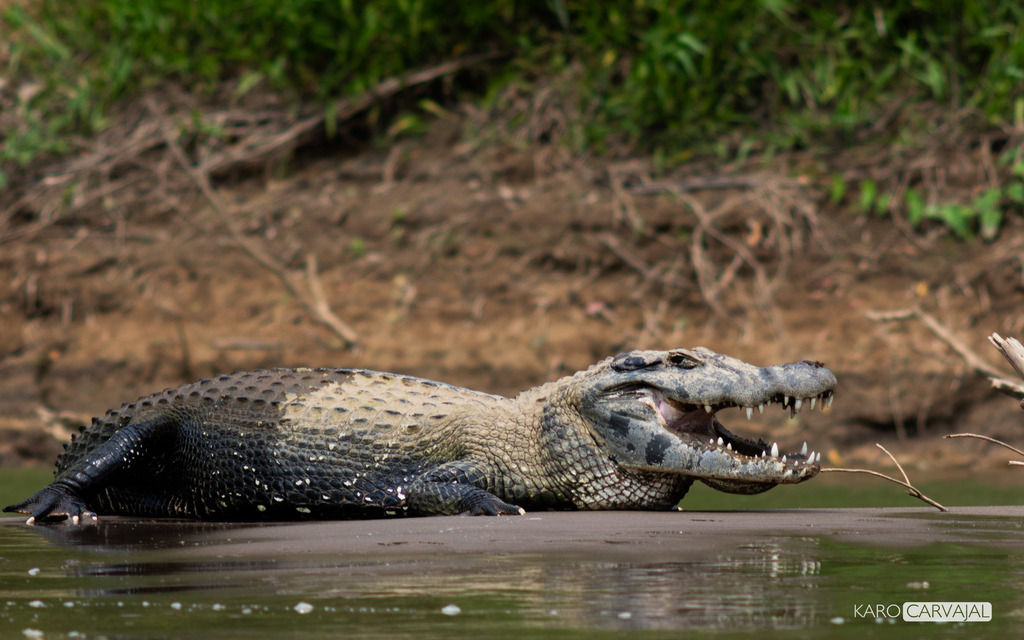
Black Caiman
Melanosuchus niger
- Class
- Reptile
- Rarity
- Common
- Observations
- 1,015
- Most observed in
- 🇵🇪 Peru
- Conservation
- Least Concern
Description
The black caiman (Melanosuchus niger) is a crocodilian reptile endemic to South America. With a maximum length of around 5 to 6.5 m (16 to 21 ft) and a mass of over 450 kg (1,000 lb), it is the largest living species of the family Alligatoridae, and the third-largest crocodilian in the Neotropical realm. True to its common and scientific names, the black caiman has a dark greenish-black coloration as an adult. In some individuals, the pigmentation can appear almost jet-black. It has grey to brown banding on the lower jaw; juveniles have a more vibrant coloration compared to adults, with prominent white-pale yellow banding on the flanks that remains present well into adulthood (more than most other species). The banding on young helps with camouflage by breaking up their body outline, on land or in water, in an effort to avoid predation. The morphology is quite different from other caimans but the bony ridge that occurs in other caimans is present. The head is large and heavy, an advantage in catching larger prey. Like all crocodilians, caimans are long, squat creatures, with big jaws, long tails and short legs. They have thick, scaled skin, and their eyes and noses are located on the tops of their heads. This enables them to see and breathe while the rest of their body is underwater.
Summary adapted from the Wikipedia article “Black caiman”.