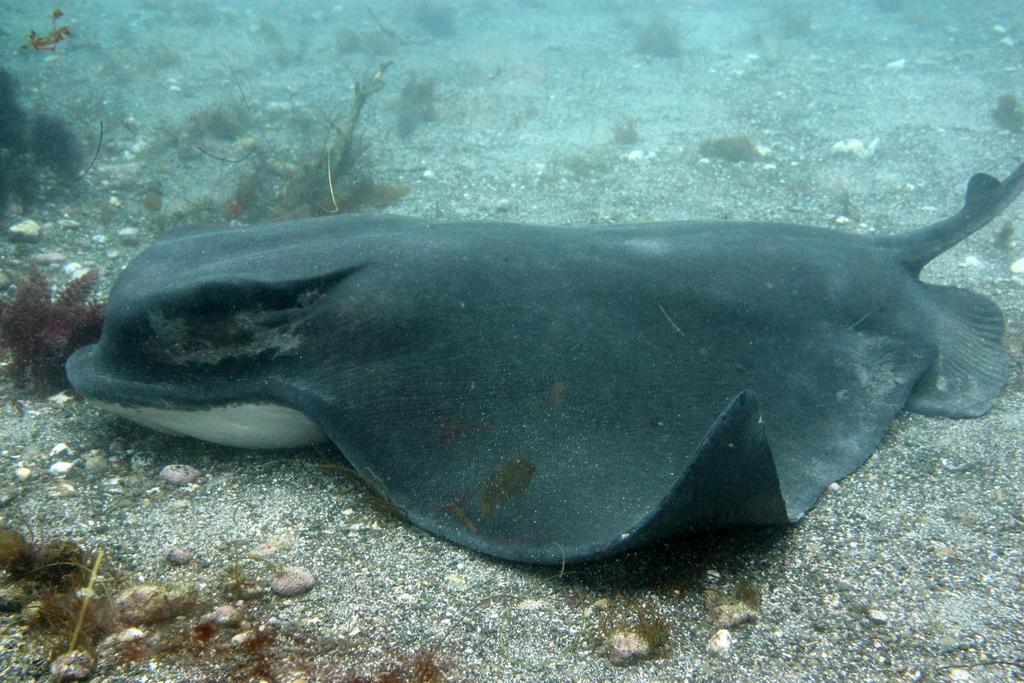
Bat Ray
Myliobatis californica
- Class
- Cartilaginous fish
- Rarity
- Common
- Observations
- 1,561
- Most observed in
- 🇺🇸 United States
Description
The bat ray (Myliobatis californica) is an eagle ray that has a diamond ray-like form that consists of pectoral fins that are wing-like and end in blunt points. The head is broad and raised higher than the pectoral fins. The eyes are laterally situated on the broad head. Below the front of the head projection is a horizontal depression. This means that instead of the head being flat, there is a slight indent in the top of the head in between the eyes. The tail is whip-like and is typically incomplete with at least one venomous spine at the base of the tail. The incomplete aspect means that the tail consists of cartilage instead of bone. The dorsal side is black or a dark brown while the ventral side is white with the exception of the areas close to the tips or disk. The largest specimens can grow to a wingspan of 1.8 m (5 ft 11 in) and a mass of 91 kg (201 lb). There is a record of this species reaching 240 pounds, however large specimens are typically closer to 200 pounds. They typically range from 9.07–13.61 kg (20.0–30.0 lb). The size of the bat ray is dependent on many factors, such as habitat alterations and different oceanographic and environmental conditions. Some bat rays are solitary, while others form schools numbering in the thousands. There has only been one record of albinism in this species during 1865 off the west coast of Baja California, Mexico.
Summary adapted from the Wikipedia article “Bat ray”.