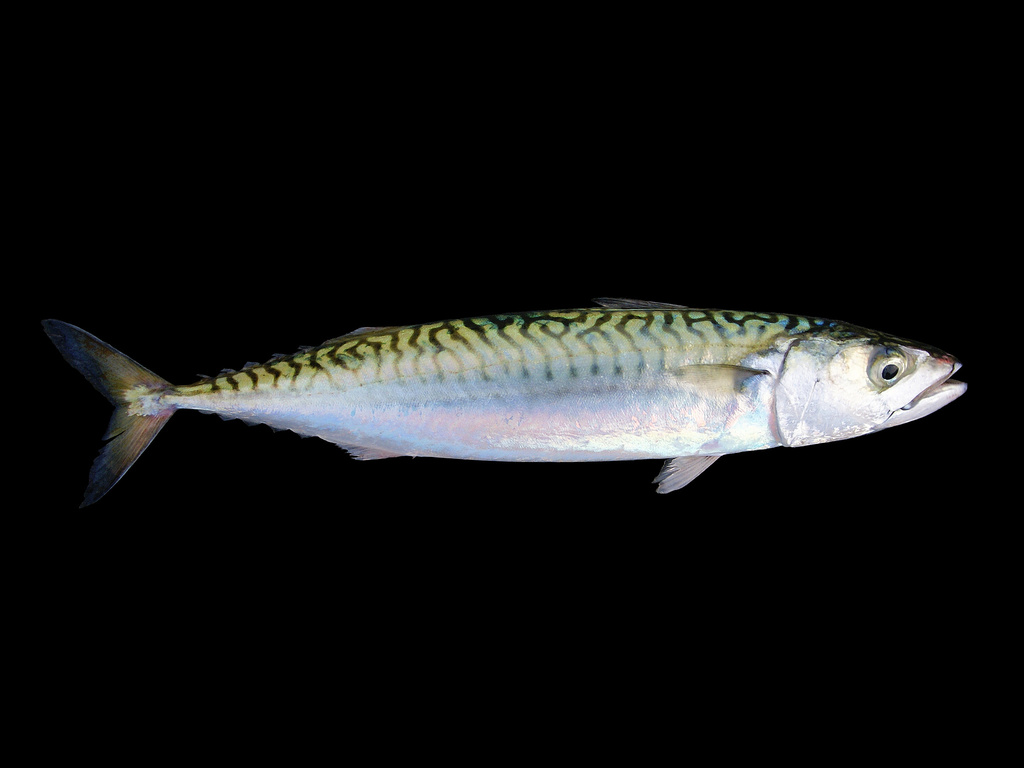
Atlantic Mackerel
Scomber scombrus
- Class
- Ray-finned fish
- Rarity
- Common
- Observations
- 855
- Most observed in
- 🇨🇦 Canada
- Conservation
- Least Concern
Description
The Atlantic mackerel (Scomber scombrus), also known as Boston mackerel, Norwegian mackerel, Scottish mackerel or just mackerel, is a species of mackerel found in the temperate waters of the Mediterranean Sea, the Black Sea, and the northern Atlantic Ocean, where it is extremely common and occurs in huge shoals in the epipelagic zone down to about 200 m (660 ft). It spends the warmer months close to shore and near the ocean surface, appearing along the coast in spring and departing with the arrival of colder weather in the fall and winter months. During the fall and winter, it migrates out into deeper and more southern water, seeking warmer temperatures. The Atlantic mackerel's body is elongate, steel-blue marked with wavy black lines dorsally and silvery-white ventrally, its snout long and pointed. It possesses two spiny dorsal fins, which are spaced far apart, two pectoral fins, and small caudal and anal fins, also spaced far apart. 4–6 dorsal finlets and 5 anal finlets are typical among members of this species. The fish's body tapers down its length, ending with a large tail fin. Typical size for a mature fish is 30 cm (0.98 ft), but individuals have been caught as large as 60 cm (2.0 ft). The maximum published weight is 3.4 kg (7.5 lb). Reproduction, which is oviparous, occurs near the shore in the spring and summer, during which a female can produce as many as 450,000 eggs. Juveniles reach sexual maturity at around 2 years of age and can live to be 17.
Summary adapted from the Wikipedia article “Atlantic mackerel”.