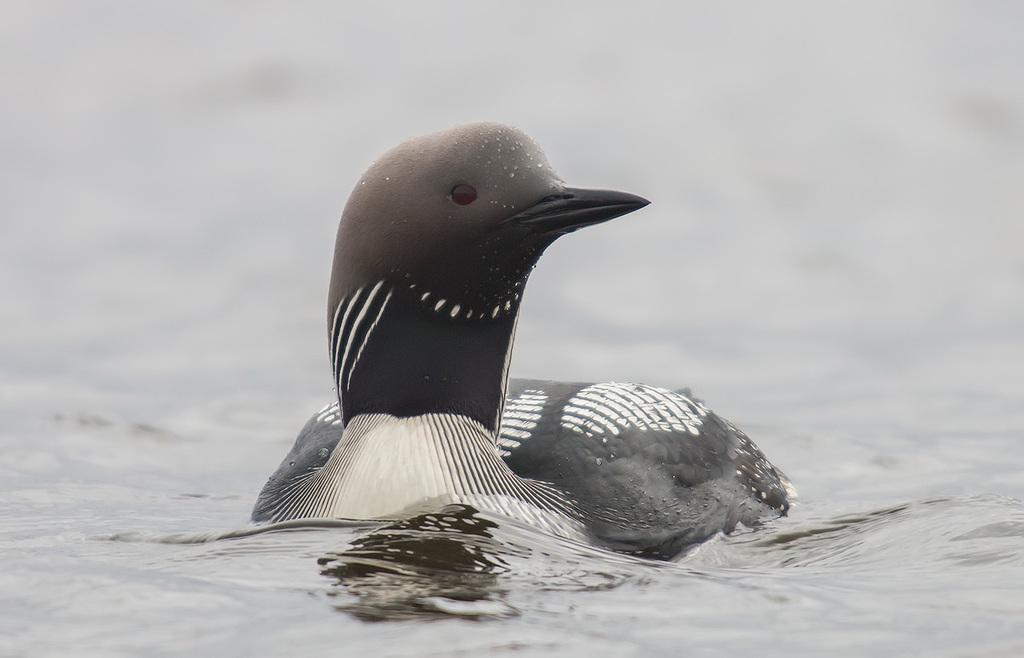
Arctic Loon
Gavia arctica
- Class
- Bird
- Rarity
- Rare
- Observations
- 4,917
- Most observed in
- 🇷🇺 Russia
- Conservation
- Least Concern
Description
The black-throated loon (Gavia arctica), also known as the Arctic loon and the black-throated diver, is a migratory aquatic bird found in the Northern Hemisphere, primarily breeding in freshwater lakes in northern Europe and Asia. It winters along sheltered, ice-free coasts of the north-east Atlantic Ocean and the eastern and western Pacific Ocean. This loon was first described by Carl Linnaeus in 1758 and has two subspecies. It was previously considered to be the same species as the Pacific loon, of which it is traditionally considered to be a sister species, although this is debated. In a study that used mitochondrial and nuclear intron DNA, the black-throated loon was found to be sister to a clade consisting of the Pacific loon and two sister species, the common loon and the yellow-billed loon. The black-throated loon measures about 70 cm (28 in) in length and can weigh anywhere from 1.3 to 3.4 kilograms (2.9 to 7.5 lb). In breeding plumage, the adult of the nominate subspecies has mostly black upperparts, with the exception of some of the mantle and scapulars, which have white squares. The head and hindneck are grey, and the sides white and striped black. Most of the throat is also black, giving this bird the name "black-throated loon". The colour of the throat patch can be used to distinguish the two subspecies; the throat patch of the other subspecies, G. a. viridigularis, is green. The underparts are mostly white, including the bottom of the throat.
Summary adapted from the Wikipedia article “Black-throated loon”.