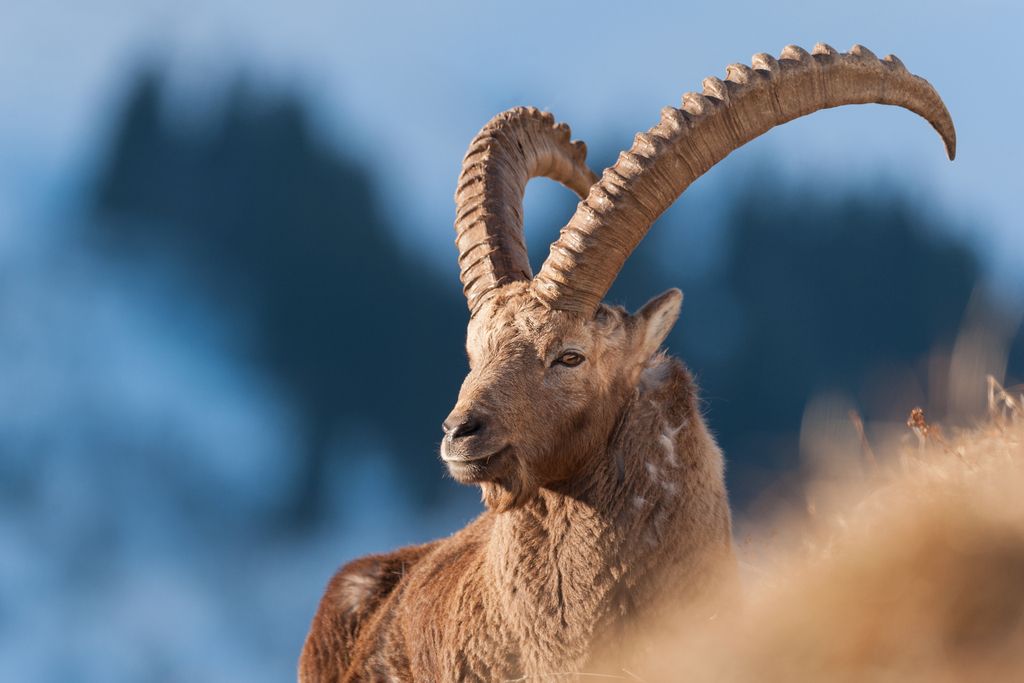
Alpine Ibex
Capra ibex
- Class
- Mammal
- Rarity
- Rare
- Observations
- 5,218
- Most observed in
- 🇮🇹 Italy
- Conservation
- Least Concern
Description
The Alpine ibex (Capra ibex), also known as the steinbock, is a European species of goat which lives in the Alps. It is one of ten species in the genus Capra, and its closest living relative is the Iberian ibex. The Alpine ibex is a sexually dimorphic species; males are much larger and carry much larger, longer horns than females. Its coat is brownish-grey. Alpine ibexes tend to live in steep, rough terrain and open alpine meadows. They can be found at elevations as high as 3,300 m (10,800 ft) and their sharp hooves allow them to scale the steep slopes and cliffs of their mountainous habitat. Alpine ibexes primarily feed on grass and are active throughout the year. Although they are social animals, adult males and females segregate for most of the year, coming together only to mate. During the breeding season, males use their long horns to fight for access to females. Ibexes have few predators but may succumb to parasites and diseases. By the 19th century, human hunters extirpated the Alpine ibex from most of its range, driving it near to extinction. It went through a population bottleneck of fewer than 100 individuals, all living in Gran Paradiso National Park, Italy. Despite its ensuing very low genetic diversity across populations, the species has been successfully reintroduced to parts of its historical range. As of 2020, the IUCN lists the species as being of least concern.
Summary adapted from the Wikipedia article “Alpine ibex”.